Thursday, March 19, 2020

Space Podcasts I'm Hooked On

Original photo by NASA


I’m hooked on podcasts. I subscribe to 45 of them, mostly space podcasts. I enjoy listening when I’m doing work with my hands such as cooking and cleaning. Working from home, I also enjoy hearing the intelligent discussions about topics of interest to me.

With a lot of us working from home and staying in these days, I thought I’d share some of my favorite space podcasts.

Are We There Yet?
This weekly podcast by radio journalist Brendan Byrne also airs on public radio in Orlando, Florida, 90.7 WMFE. The title refers to the long road to get humans to Mars. In 28 minutes, Brendan gives quick space news updates at the start, followed by an interview with a space expert, followed by a segment with three UCF professors on space topics of interest.

Astro, Esq.
This space law podcast by Nathan Johnson, still on break from its first season in 2019, features interviews with various experts involved in space law and policy in 40 minute segments.

Constellations
This space security podcast by Kratos, published approximately twice per month, gives updates about new satellite technologies in 20 – 25 minute segments.

Gravity Assist
This NASA podcast by NASA Chief Scientist Jim Green, still on break from its third season in 2019, published 10 to 15 episodes per year. It features 20 – 25 minute interviews on NASA science missions.

Houston We Have a Podcast
This NASA weekly podcast produced at Johnson Space Center features hour-long interviews about NASA missions and technology, occasionally by astronauts.

Liftoff
This biweekly podcast by Stephen Hackett and Jason Snell of Relay FM, ranging from 30 to 75 minutes long, gives an overview of the space news topics of the moment.

Main Engine Cut Off (MECO)
This weekly podcast by Anthony Colangelo, alternates between shorter space news updates (10 – 20 minutes long) and longer interviews with experts (30 – 60 minutes long).

Mission Eve
Still on break from its first season in 2019, this weekly podcast by Meagan Crawford of the Center for Space Commerce & Finance features 30 – 60 minute interviews with women in the space sector.

NASA in Silicon Valley
This NASA podcast produced by Ames Research Center recently switched formats. It now features live recordings with multiple interviews per segment throughout the year.

Off-Nominal
This monthly podcast by Jake Robins and Anthony Colangelo features hour-long interviews with experts on various topics of interest, space-themed drinks, and space picks of the month.

On a Mission
This NASA podcast produced by JPL is still on break from its second season in 2019. This weekly podcast, 35 to 45 minutes long, features NASA science missions in a storytelling format.

On Orbit
This 30 – 60 minute weekly podcast by On Orbit features interviews by experts in themes such as “connecting the unconnected” and other satellite communications topics of interest.

Planetary Radio
Produced by the Planetary Society’s Mat Kaplan, this weekly podcast 45 – 75 minutes long features interviews with Planetary Society leaders and outside experts, news updates, an overview of what’s currently visible in the night sky, a trivia contest, and a monthly space policy edition.

Small Steps, Giant Leaps
This NASA podcast published once or twice per month looks back at the Apollo program and forward to NASA’s plans in the Artemis program.

Space Junk
This hour-long mostly weekly podcast by OPT Telescopes gives practical information about stargazing and astrophotography as well as featuring interviews with experts.

Space4U
This monthly podcast by the Space Foundation features 20 – 40 sometimes multi-part interviews with experts on a variety of space topics.

Spacepod
This monthly 15 - 30 minute podcast by Carrie Nugent features interviews with space scientists and unusual drinks.

SpaceQ
This formerly weekly podcast but now being produced a bit less often by Marc Boucher of SpaceQ features space topics of interest to the Canadian space sector, sometimes news updates, sometimes interviews, and sometimes audio recordings of events.

Supercluster
This mostly weekly podcast usually 30 – 60 minutes long features an overview of the space news of the moment plus occasional interviews with experts.

The Invisible Network
This weekly NASA podcast, currently on break, features interviews and stories about space communications and navigation in 15 – 40 minute episodes.

The Orbital Mechanics Podcast
This weekly 30 – 90 minute podcast by David Fourman, Ben Etherington, and Dennis Just features discussions on space news of the moment, a space trivia contest, and occasional interviews with experts.

The Rocket Ranch
This NASA podcast produced by Kennedy Space Center once or twice per month features 30 – 45 minute episodes on various NASA historic and current events topics in a storytelling format.

The Space Above Us
This biweekly podcast by by JP Burke gives an in-depth look of every historic NASA mission, one mission per episode, from Mercury to Space Shuttle (as of this writing, he’s up to STS-33), in 20 – 40 minute episodes.

The Space Angels Podcast (now Space Capital Podcast)
This 30-minute podcast by Chad Anderson, produced a few times per year, features interviews with companies in the Space Angels portfolio on various space technologies and other space experts on space entrepreneurism and the commercial space industry.

The Space Shot
This 15 – 30 minute weekly podcast by John Mulnix features a look back at historical space anniversaries of the week with occasional interviews with experts on a variety of space topics.

TMRO
This 45 – 75 minute weekly live recording video broadcast (which I listen after-the-fact in podcast format) features space news, interviews with experts, and space discussions.

Universe Today
This podcast by Fraser Cain publishes several episodes per week including hour-long live video question & answer sessions, 10-minute segments on a space topic, and 30-minute interviews with experts.

WeMartians
This biweekly podcast by Jake Robins features 30 – 45 minute interviews with experts on a variety of Mars-related topics.

All the above podcasts are presumably active. But I want to mention one limited-production podcast released last year:

Moonrise
This 12-part storytelling podcast series by The Washington Post’s Lillian Cunningham on the history of the Apollo program, starting from early science fiction to the Apollo 11 Moon landing, was excellently researched and produced. I learned a ton of space history from these accounts.

Since publishing this blog entry, I’ve received many great suggestions from readers! I’d like to add for your consideration:
13 Minutes to the Moon by BBC World Services
Casual Space by Beth Mund
Satellite Stories by SES
Terranauts by Iain Christie

This is not an extensive list. There are other space podcasts out there. What’s your favorite space podcast?

Monday, March 16, 2020

The 7th Next-generation Suborbital Researchers Conference


Before the chaos of the coronavirus and mass cancellations, there was the 7th Next-generation Suborbital Researchers Conference. I’ve attended all 7 of them, usually spaced 1.5 to 2 years apart. This year, I was a member of the organizing team. In addition to running the social media accounts, I organized a panel and helped with other things along the way. Additionally, I gave a talk and was a panelist for another panel.

It was fun but anxiety-inducing to organize a panel on the connection between suborbital research on new vehicles launched by Blue Origin and Virgin Galactic and orbital research on the ISS. I’ve organized panels before and have no problems identifying and inviting potential panelists. I confirmed four speakers: two ISS managers (one from NASA and one from my former employer CASIS / ISS National Lab, a nonprofit that handles Earth-benefitting ISS research) and two researchers who have flown experiments to suborbit and orbit (a NASA engineer and a university medical doctor and professor).

What made this panel different was a SpaceX CRS launch to the ISS scheduled Sunday night after the official start of the conference. Two of my panelists were attending the launch. If the launch was delayed a day, they would be unable to attend my panel and I’d be down to two panelists. It turns out the SpaceX launch was delayed – by 5 days! So my panelists attended the conference and then attended the launch.

Snow! Just before conference kick-off on Sunday.

In addition to constant social media posting and engagement, I staffed the registration desk Sunday evening and Monday morning. I’m an extrovert, so greeting people when they arrive is fun. Find their name badge, hand them their program and flyer packet, give them some give-away swag (this time, a conference pen and a Virgin Galactic “remove before flight” keychain tag), let them know about the ZeroG Corporation raffle, and ask if they have any questions. If they are a friend, catch up a little bit with small talk. If they are a journalist, student, or VIP, there was additional information to tell them. I had helpers during both sessions who I trained to take over when things got too busy.

Sunday evening was the conference opening reception. We wandered around the hotel’s side lobby while caterers carried plates of food around and a couple Colorado politicians spoke words of welcome. I spent most of the time at the registration desk but ran off for a few minutes at time to take photos of the speakers for social media posts and grab some food.

As he was filling out his raffle ticket, three-time space shuttle astronaut and first commercial astronaut Charlie Walker, who I’ve met several times at this conference throughout the years, informed me that he had experienced plenty of microgravity time and would give away his ZeroG parabolic flight ticket if he won. He offered to give it to me. What a story that would be – an astronaut winning a raffle and giving away his ticket! Every time he saw me at the conference, he knew the exact number of hours until the winner would be selected on Wednesday morning. He was so excited about it for someone who didn’t plan to keep the winnings!

Astronaut Charlie Walker filling out his ZeroG Corporation raffle ticket

Alan Stern kicked off the talks Monday morning. Although he is a planetary scientist and can speak endlessly about Pluto and other Kuiper belt objects, he’s also passionate about the commercial space industry and suborbital science. This conference is his baby and he has tickets to fly himself with an experiment someday. As a grad student, Alan was my inspiration realizing I could be a scientist and work in the space industry simultaneously, that the two worlds can come together.

Other Monday morning speakers included Ryan Hamilton of Southwest Research Institute, Kevin Coleman of the Federal Aviation Administration’s commercial spaceflight office, George Whitesides of Virgin Galactic, Steve Squyers of Blue Origin, Eric Stallmer of the Commercial Spaceflight Federation, Steven Collicott of Purdue University and CSF SARG, and finally, my favorite, NASA Administrator Jim Bridenstine, who high-fived me as he was boarding an elevator after his talk.

NASA Administrator Jim Bridenstine speaking at NSRC-2020

Fellow book author Alan Ladwig had a whole table for book signing. His book is a historical look at space tourism. I had brought 6 copies of my book to sign and sell. We traded: a signed copy of mine for one of his. He’s also an artist and doodled as he signed. He gave a talk about his book during the conference which was great because it was full of amusing old stories.

Alan Ladwig and I showing off our books at NSRC-2020

I attended as many of the talks as I could so I could be there with my phone to take photos and write up content for social media. I was constantly sharing the posts of others as well. It kept me quite busy. I didn’t take as much time as I usually do to network in the hallway.

My talk was second-to-last Monday afternoon. I presented insights on how to market suborbital spaceflight to millennials based on the research I conducted for my book. I didn’t know if anyone would still be in the room or if they’d be off at the poster and networking session starting 15 minutes later. There was still a small audience, so I gave it my best. And despite some initial technical difficulties displaying my presentation correctly, it went great! There was no time for audience questions, but I got so many complements after the talk.

I wrote up a one-pager on how to market spaceflight to millennials, available here.

Giving my talk on how to market spaceflight to millennials at NSRC-2020

Tuesday was exciting to me because of one newly arriving attendee: Beth Moses. She is Virgin Galactic’s astronaut trainer. In 2018, she became the first woman astronaut on a commercial vehicle, the first woman suborbital astronaut, and the first person to unstrap and float around in a suborbital spaceflight. She was the seventh person to be awarded FAA commercial astronaut wings, the first six being pilots and she being the first passenger. She’s my suborbital astronaut role model.

I met her briefly at the registration desk, which I wasn’t working at the time but happened to be there resting. I sat front row to watch her panel with Michelle Peters of ZeroG on how to train for microgravity research missions. I finally got a chance to pose for a photo with her at the VIP reception that evening.

Meeting Beth Moses

Tuesday was also the panel I organized which went quite well! We only had a few minutes for audience questions, but the information presented was great and Q&A session went well too. Mission success.

The very last hour of the Tuesday afternoon sessions was the panel I was added to a week before the conference on the importance of researchers flying with their research on suborbital spaceflight missions. There were seven panelists, which is a huge number for a one-hour panel, but it worked out pretty well. Only astronaut Charlie Walker gave intro slides and the rest was Q&A. I took a different approach than most of the others and spoke about what I learned from researching for my book about normalizing spaceflight, creating that human connection, bringing spaceflight to the masses to stabilize the field financially and politically the way we take air travel for granted today, and opening space to other scientific disciplines such as psychologists researching the way humans perceive the planet and ourselves after experiencing spaceflight.

Wednesday was the final day of the conference. I sat in on talks by my graduate advisor Josh Colwell and former lab college Addie Dove of UCF, reminiscing about the experiments I spent years on in grad school.

The two raffle winners were announced for free tickets on ZeroG’s “weightless” parabolic aircraft flights. I’ve flew two campaigns in grad school and absolutely loved it, even though I got sick. I’d still fly again in a heartbeat! I was chatting with my former CASIS colleague Ed Harris who now works at Keck Observatory in Hawaii. He was in the middle of telling me that if he won, he plans to donate his ticket to a scientist in Hawaii who can fly Hawaiian student experiments, when suddenly the whole lobby was looking over at us. Ed had won! I’m so glad because his generous donation to support Hawaiian schools is much better than me flying for a third time.

The final session of the conference, right after lunch, was full of more top speakers. My favorite space journalist Jeff Foust of Space News gave an analytical view of suborbital spaceflight: where it was predicted to be, where it is now, and where it could grow to be. Beth Moses gave another talk, this one a more detailed look at her job as an astronaut trainer and research facilitator with more details about her own spaceflight. Dylan Taylor of Space for Humanity inspiring talk about the philosophy of opening up spaceflight with ideals that mirror my own. And Alan Stern wrapped up the conference with thank-yous.

Those 5 remaining books I brought with me to autograph and sell? I sold all of them! I probably could have sold a couple more if I had brought more.

Why do I continue being involved in NSRC when my work is now broader and I’m no longer directly working with suborbital research? It’s a small an intimate gathering, a welcoming community, a good mix of multidisciplinary attendees and presenters, and very forward-thinking topics. It’s a seamless fusion of science, engineering, public outreach, government, and commercial space. And because it’s not annual, it’s not repetitive in an ever-changing field. Even though my work is broader now, I still wish to be a suborbital astronaut/ space tourist. When I fly, I’ll take an experiment with me. I’ve trained to be a suborbital scientist. Aside from a lunar astronaut, suborbital astronaut who I desire to become.

Friday, February 21, 2020

How Far Millennials Will Soar in Space

Original image courtesy of NASA
One of the most inspiring results of my research interviewing over 100 millennials working in the space sector or studying to work in the space sector was the optimism about the future. Although not unanimous, most millennial interviewees hold high hopes and high expectations for the future. I asked them what they expected millennials will accomplish in space in their lifetimes. The responses formed the final chapter and my favorite chapter of Rise of the Space Age Millennials – How Far We’ll Soar.

It’s impossible to predict the future. But it’s fun to try. My millennial interviewees took a chance at peering 30, 40, 50 years from now to ponder what the world may become. Specifically, what humanity will discover and achieve in space. Much of the focus on space achievements last year was celebrating the past: the 50th anniversary of the Apollo 11 Moon landing. I wanted to understand what millennials believe we’ll accomplish 50 years from now.

Some interviewees hesitated to imagine too far into the future, if at all. They took some safe bets. Humans will return to the Moon and establish a permanent base or settlement. If NASA’s plans come to fruition in the Artemis program, we will return astronauts to the Moon as soon as 2024 (although more realistically somewhere in the 2025 – 2030 time frame).

Spaceflight frequency and affordability will increase, perhaps bringing spaceflight to the masses with suborbital point-to-point transportation. Suborbital and orbital tourism will take off. The early 2000s saw the first space tourists travel to the International Space Station. Very soon, we hope to see Virgin Galactic and Blue Origin begin suborbital space tourism and SpaceX begin orbital and cislunar tourism.

We will continue to pursue space resources on asteroids and elsewhere, perhaps maturing in-situ resource utilization (ISRU) technology. Although the previous and existing asteroid mining companies were early efforts that have not yet accomplished their goals, perhaps future efforts on asteroids, the Moon, or Mars will help humanity obtain off-Earth resources which are limited on our planet but plentiful elsewhere. Or perhaps water will become the most valuable mined resource in space.

We will be able to observe exoplanet atmospheres in more detail. Exoplanet science is only three decades old and already we’ve discovered over 4,000 confirmed exoplanets. Peering into the atmospheres of these distant planets orbiting distant stars is the latest scientific break-through. Comparative planetology will help us to understand our own planet and how planets are formed and evolve. The search for biosigatures on these distant worlds is vital to the search for extraterrestrial life.

We may even advance beyond chemical rocketry to more efficient modes of propulsion. Nuclear thermal fission, ion engines, plasma propulsion, solar sails, even nuclear fusion may be able to advance our rocket and spacecraft technology to faster and/or less expensive spaceflight.

Most interviewees believe they will see astronauts step foot on Mars within their lifetime. The call of the red planet is strong and is widely believed to be the next goal in human space exploration after the Moon. Some even believe we’ll begin to establish a permanent base on Mars in the coming decades, officially becoming a multi-planetary species.

Some interviewees foresee the creation of private space stations for space tourism and other applications. Companies such as Axiom Space and Bigelow Aerospace already have plans to create their own low-Earth orbit destinations. Some foresee multi-generational spacecraft for deep space exploration.

Some believe we’ll find evidence of past or present extraterrestrial life, whether in our Solar System or on an exoplanet, forever changing our perspective of the Universe and of ourselves as a species.

Some of the idealists interviewed hoped to see space unify humanity in the form of an international partnership that rises above the geopolitics of the present. We can become representatives of one planet as we progress outward to explore new planets. We may even come together to accomplish interstellar space exploration.

Wherever we go in the future, whatever we are able to accomplish in my lifetime, writing Space Millennials has given me renewed hope that the space sector is in good hands with the next generation and those to come.

Have you gotten your copy? You can find it on Amazon or visit https://www.astralytical.com/rise-of-the-space-age-millennials.

Friday, January 24, 2020

The Marathon that is Writing, Publishing, & Selling a Book


This is the tweet that began the creation of the book, Rise of the Space Age Millennials: The Space Aspirations of a Rising Generation. It was just a thought, an idea that popped into my head. I never thought of myself as a book author. And yet a little idea kicked off an almost four-year process of researching for, writing, and publishing my first book.

“Are you writing this book for fame or for money?” a few people asked me along the way. Ha, neither! I knew from the start this would be a niche book with a tiny customer base: space-interested millennials and space-interested readers of other generations to some extent. I never dreamed this would be a New York Times Best Seller or that it would make me thousands.

True to my nature, before writing the book, I researched how to publish a book. I read a lot of guides and personal accounts. I was under no illusions. According to a statistic I found, most self-published books sell fewer than 250 copies ever. Knowing how tiny my market is for this book, I decided I’d be pleased if I sold 10 books. Last year I ran a Kickstarter fundraiser and pre-sold 34 books, so I increased my goal to 100 books. Selling 100 books does not bring fame nor fortune.

So why write it? Because no one else had. It was a topic I was interested in and there was no other resource out there like it. Millennials get a bad reputation due to stereotypes filled with half-truths that didn’t ring true to me. My goal was to give my millennial peers a voice. I wrote the book for myself and for them.

Being a scientist, the first thing I wanted to do was collect data. I interviewed over 100 millennials (101 to 103 depending on how I count it) with a set of questions covering topics ranging from space inspirations, work preferences, connectivity, and space goals. I’m a physical scientist, not a social scientist, so creating interview questions and interpreting the answers stretched me. I did the best I could to represent their views.

My initial introduction draft contained all kinds of statistics. Workforce demographics in the US, at NASA, and at companies such as SpaceX. Statistics about my millennial interview panel. A look at how millennials compare to previous generations. I come from a scientific background and I approached the presentation scientifically. But that doesn’t make for good storytelling. Book writing is entirely different from the technical writing I’m used to. I scrapped that version and instead focused on individuals’ stories and the trends as a whole. I wrote the book with a space-interested audience in mind but with a clarity that could be understood by anyone.

One of my biggest downfalls was impostor syndrome, the fear that I’m not worthy to be doing what I’m doing. After all, I have no formal training in book writing and I’m not famous. Why would anyone want to read a book I wrote? Why would people spend money on my book? How dare I think my writing is good enough to be read by the masses. This fear still plagues me. The only motivation that pushed me forward was reading so many bad books in the past couple of years. I’ve disliked or felt ambivalent about most of the books I’ve read for pleasure recently, both modern and “classic.” Yet those books were still published and sold, recommended to me, and ended up in my hands. If they could do it, so could I.

Unfortunately, negative feedback did paralyze me. Approximately 3 years ago, before I had even begun writing, I presented my initial research results to a local AIAA chapter. The room was filled with members of the silent generation and baby boomers, maybe a generation Xer or two. Aside from me, there was only one other millennial in the room. I presented direct quotes from my interviews and explained some of the trends I was beginning to see. They hated it. They disagreed with it. They fought back on everything I said simply because it was counter to their worldview. Nothing I said helped them to overcome their initial biases to understand the material I was presenting. I left my own presentation early, feeling dejected and disillusioned. If I couldn’t convince a space-interested crowd of the value of my material, why write the book?

Time passed. I suffered a computer crash and then another. I lost files. I built up my business. I got pregnant and had a second child. In the passing time, I had moments of motivation that encouraged me to work on the book, but that never lasted long. The book was largely shelved.

Eventually I realized if I didn’t motivate myself, all my hard work up to that point would be for nothing. So last year, on my birthday, I ran a Kickstarter campaign. I created draft cover art and a promotional video. I asked people for help in acquiring initial funds to pay for art, editing, and publishing. My goal was $1,000 and I raised over $2,300 which also gave me enough funds to create an audiobook. The support was truly motivating! Plus, I knew if I took people’s money in pre-sales, I would finish the book.

But it still took time. Last year was the busiest yet for my small business. I got pregnant and had a devastating late miscarriage. Progress was slow and I needed an end date. I had planned for April, which got pushed to the summer, which got pushed back even later once I realized how many Apollo anniversary books were flooding the market. Finally, I settled again on my birthday, January 17. Book launch day.

Before I knew it, it was November and my manuscript wasn’t yet completed! I worked as best I could for weeks, finally getting it to my publisher in December. I knew I was cutting it close.

My initial dive into self-publishing reading almost 4 years ago led me to believe self-publishing was easier than traditional publishing, especially for a first-time author. The freedom, flexibility, speed, and increased royalties in self-publishing appealed to me. I doubted I could get a publisher to agree to my tiny niche market book. And yet, nothing about self-publishing is easy! I learned the hard way over and over that first-time authors who self-publish have a lot to learn.

I hired a freelance artist to redesign my cover art and to make a spine and back cover. At the time, I did not know anything about trim sizes and page numbers. After a few iterations, I was pleased with the final product. Only much later did I realize the dimensions of my cover art were all wrong! Cover art unexpectedly ended up being the most frustrating part of the entire book publishing experience. After 6 or 7 tries, I think I’ve finally gotten the cover art to where it’s supposed to be, even if it is a little stretched.

Last-minute I decided to hire another artist, a talented young woman in the space industry, to create interior art. Working with Caroline was a breeze and my chapters now begin with her beautiful little illustrations. It’s the details that make the book format so enjoyable over a blog or other plain text communication.

I expected editing to be tough, but it wasn’t as bad as I thought it would be. I had done a fair amount of proof-reading ahead of time. But it’s always humbling to see just how many mistakes I made without even realizing it. My editor Bart offered so many wonderful suggestions, the hardest part was implementing them all in the time constraint I had. Although I know I missed some mistakes, including an embarrassing one I caught during the typesetting process, I’m pleased with the quality of the book. I’m never pleased with the quality of my writing, but it is what it is. I’ll never be as good of a writer as some, but I’m better than others.

I hired another freelancer to format and typeset the book for print and ebook formats. He did a decent job, but after a few iterations to fix all the little mistakes, I really felt the time crunch. It was under one week until book launch!

I also learned last-minute, as I was preparing my book launch webpage, media kits are expected. I knew of press kits from rocket launches, not book launches. In the final days before book launch day, I created a media kit with a press release, photos, information, and even a mock interview.

As much as I had read and read about self-publishing, I was not prepared for the nightmare that is the publishing process on Amazon. Publishing the ebook (both on Amazon and Barnes & Noble) was fairly straightforward and I had that task accomplished days early. But print publishing was another story.

For such a huge company that almost holds a monopoly on self-publishing, Amazon’s instructions are atrocious. I give them a D for unclear and contradictory information, vague error messages, and long response times (approximately 20 hours between submissions and rejections). Finally, a day late, the paperback was on sale. But it was an early customer who informed me the art wasn’t great and I needed to fix it. So, finally, now the paperback is on sale and in good shape, no thanks to Amazon.

Amazon conveniently ignores Prime user status when selling author copies. So not only do I need to pay for shipping boxes of books, I also need to wait longer than the standard 2-day delivery. It’s embarrassing to me I still haven’t shipped out pre-order books, let alone the autographed books that have been ordered over the past week since book launch. But, it will be done by tomorrow morning when I can finally get to the post office.

After doing even more reading about marketing, I’ve come to understand book sales are a marathon, not a sprint. Book launch is just the beginning. I did a little bit of organic social media marketing before book launch and over the past week, plus documenting my findings and experiences in this blog. My goal to sell 100 books has almost been reached. As of this writing, I’m 90% there.

I did three podcast interviews about the book prior to its release and I have a radio interview lined up soon. I’m giving my first live audience talk about the book at a conference in March, specifically about how to market space and space business to space-interested millennials. I plan to turn that talk into a guide to publish for free on my company’s website. Marketing will continue until the book topic is no longer relevant, which may be when millennials really are running the space sector.

Publishing Space Millennials isn’t over yet. This weekend, I’ll play with my new microphone and pop filter. I’ll download audio recording software and try to get an idea how to create an audiobook. Over the next few months, I’ll record myself narrating the book for the readers who prefer to listen.

My dabble into book writing and publishing isn’t over yet. For over a year now, I’ve had an idea for a second book, but I haven’t allowed myself to pursue it until this book is completed. The topic: how to prepare and what to expect as a space tourist. Wish me luck!

To purchase Rise of the Space Age Millennials and help me reach my goal, visit: https://www.astralytical.com/rise-of-the-space-age-millennials .

Edit: Goal of 100 copies sold achieved in the first 9 days. Thank you all!

Friday, January 10, 2020

What Inspires Space Millennials?

Original image by NASA
Will millennials become the Artemis Generation?


“I have a celebrity crush on Elon Musk. I love his brazen, fearless approach. I see him doing more than just energizing space exploration itself; I see him inspiring my generation to be bold and fearless in the face of 'impossible' missions.”
- Interviewee quote from Rise of the Space Age Millennials.

Apollo inspired a generation. In a short time, NASA accomplished the seemingly impossible. The iconic Apollo 11 Moon landing unified much of the world as people from all walks of life gathered around TVs to watch those first steps into a new era.

Many from the Baby Boomer generation (born 1946 – 1964) remember this defining moment from their childhood or early adulthood. Some were so captivated by the moment and the movement, they pursued space careers and remained lifelong advocates of space exploration.

Last summer, the United States celebrated the 50th anniversary of Apollo 11 with great fanfare and reflection. Nostalgic essays, books, and films looked back on the grand days of the early space program and the feats NASA was able to accomplish.

But for many, including millennials (born approximately 1981 – 2000), Apollo 50th anniversary celebrations were a source of frustration. Millennials were not yet born during those glory days. No one from the millennial generation or Generation Z (born approximately after 2000), and many from Generation X (born approximately 1965 – 1980) have ever seen humans step foot on another world. If we could land humans on the Moon 50 years ago, why can't we do so today?

Older millennials grew up during the era of the Space Shuttle program. For many, their source of inspiration were astronauts floating in the International Space Station, doing somersaults, playing with droplets of water, and advancing science. For many millennials in the United States, the space shuttles were all they knew of vehicles capable of taking humans off-world.

Robotic space voyagers also served as a source of inspiration for generations born after Apollo. Mars rovers Pathfinder's Sojourner (landed 1997), Mars Exploration Rovers Spirit and Opportunity (landed 2004), and Mars Science Laboratory's Curiosity (landed 2012) brought the red planet into the imaginations of the millennial generation. The astrophysics-advancing Hubble Space Telescope (launched 1990), Saturn-exploring Cassini–Huygens (launched 1997), Pluto-imaging New Horizons (launched 2006), and exoplanet-hunting Kepler Space Telescope (launched 2009) are also among the missions that inspired millennials to contemplate the cosmos.

But by far, the #1 source of inspiration and excitement cited by over 100 millennials I interviewed for my upcoming book, Rise of the Space Age Millennials (released January 17, 2020), is the emerging commercial space industry, or “NewSpace.” Top of the list: SpaceX with its charismatic founder Elon Musk and its impressive rocket booster landings, enormous Starship, and ambitious plans, including human missions to the Moon and Mars. The quote at the top is by a millennial interviewee in Space Millennials and echoes many of the other interviewees' sentiments.

With feats never before seen (landing two rocket boosters back to the ground simultaneously) to public-engaging showmanship (launching a Falcon Heavy carrying a Tesla Roadster with a spacesuited mannequin playing David Bowie music), it's no surprise SpaceX motivates and excites millennials just now entering and growing in their space careers. Other sources of NewSpace inspiration from my millennial interviewees: Blue Origin, Virgin Galactic, and Bigelow Aerospace.

This isn't to say Apollo didn't also inspire millennials. Apollo inspired me when I was a child. NASA's current human exploration Moon-to-Mars program Artemis calls the explorers of this time the Artemis Generation. When humanity returns to our nearest celestial neighbor again, many will be inspired for generations to come. Perhaps, with determination, luck, and public-private partnerships, millennials and Generation Z will be celebrating the Apollo 11 centennial from on the Moon in 2069.

Friday, January 3, 2020

Rising Space Millennials to Mars & Beyond

Mars image courtesy of NASA


Astronauts landing on Mars. Permanent settlements on the Moon and Mars. Private space stations. Advanced rocket propulsion. Deep space tourism cruises. The discovery of life on one of our Solar System moons or a distant exoplanet. Even global peace and unity through space activity. These are some of the predictions and dreams space millennials have for their time in the workforce as described in my upcoming book, Rise of the Space Age Millennials.

The summer of 2019 was all about reliving the glory days of Apollo (as we remember them now). The astounding achievement of landing astronauts on the Moon in 1969 deserves the praise and celebration it received 50 years later. Written accounts and oral histories contributed to our nostalgic reflections on what we've accomplished over the past half-century.

Relatively few pondered what we'll accomplish over the next half-century. Where will humanity be in space when we celebrate the centennial of the Apollo 11 lunar landing? Can you imagine 2069?

The generations that built the early space age will be long gone by then. The current rising working generation of millennials will be nearing retirement. Generation Z and the generations to come will be carrying the torch forward for humanity into the cosmos. I asked approximately 100 millennials working in the space sector or studying to work in the space sector what they hope we will accomplish before we retire.

Refreshingly, their outlook was bright! A few cynics offered skepticism we'd get much farther out into space than we already are. But the vast majority of respondents had lofty goals and high expectations. I fully admit to a selection bias in my sample. All respondents were working or pursuing work in a field they love and only those willing to share their dreams with me responded. There's also something to be said for the optimism of youth before it's crushed into realism and cynicism by delayed projects, canceled programs, and broken promises. And yet, millennials in their 20s and 30s who have already seen their share of shifting priorities and timelines still remained optimistic.

Mars Mars Mars. No destination calls to millennials the way Mars does. Many millennials shared my desire to return humans to the Moon, but almost universally, Mars was the most important goal. Just about every one of the millennials respondents believes they will witness humans land on the red planet in their lifetimes. NASA's current focus on taking the Artemis Generation to the Moon, then Mars, just as Constellation and other programs previously promised, is in line with millennial expectations for the future. Whether it's a government program or a private company such as SpaceX, millennials assume a future on Mars.

How we get to Mars is still an area of active debate. Some millennials call for a push reminiscent of the Apollo era, complete with an Apollo-sized NASA budget, to achieve a grand goal for the global space community. Some millennials call for a more incremental approach, improving life support systems, radiation shielding, and propulsion technology before sending our pioneering astronauts deeper into space than ever before. Some call for a large government initiative while others put their faith in the ambitious of innovative new companies. The path we take is still to be written.

Who participates will look different than the Right Stuff astronauts of 50 years ago. Millennials in the United States represent a more diverse racial, ethnic, and cultural population than previous generations. Each successive generation is getting more diverse. On average, millennials also value diversity and inclusivity more than their older colleagues. Many millennials I interviewed mentioned the imperative of a more representative space workforce and the importance of involving the international community. Future human expeditions to Mars will be more representative of the global population.

It was a pleasure getting to know my peers better through these interviews. For more insights on these topics or others, I invite you to read Rise of the Space Age Millennials (released January 17, 2020).

Friday, September 13, 2019

The Long, Uncertain Path to Influencing in the Space Community

Having Fun at the Brooke Owens Fellowship Summit, July 2019


For as long as I can remember in my adult life, I’ve been trying to prove myself. My constant effort balancing multiple projects, most unpaid to gain experience, recognition, or networking. My all-too-frequent battles with impostor syndrome, a war within myself to conquer self-doubts and dismiss undue self-criticisms. The hunts and races seeking admission into projects or meetings or circles I felt I belonged in or could belong in if given the chance to grow. The unresolved questions following rejection or disregard: Is it me? Is it my age? Is it my gender? Is it my reputation? Is it something within my control to change or maddingly outside of my control? Despite earning and pushing my way through many doors, I too frequently feel as an outside looking in, striving for more acceptance and more opportunity to prove I can do this.

I was largely ignored by my professors as an undergraduate student, as most undergrads are, only gaining recognition and acceptance by them after I had graduated and proved myself with additional successes. I was ultimately rejected by my primary advisor in my first graduate school, being issued an “it’s my way or the highway” ultimatum and choosing the highway, boldly and unabashedly choosing my own path. I was bullied by a peer in my second graduate school and my self-confidence plummeted despite my more advanced successes. My first full-time job kept me locked in a cage, refusing to allow me the space to grow despite my frequent cage rattlings and occasional breakouts. It was only in my second full-time position when, given the title of Manager and the freedom of flexibility and responsibility, I began to feel myself thrive. Unfortunately, that position didn’t last when the company declared bankruptcy.

My true acceptance of my career success and space community membership didn’t come until I started my own company Astralytical nearly 4 years ago. But it didn’t come immediately. That first year I felt as though I was grasping at straws, pursuing any potential path forward, frequently ignored or worse: being led down rabbit holes by insincere promises and exploitations. The pride I felt signing my first two clients was quickly deflated when the first could not pay me as promised and the second took advantage of my naivety and lack of internalized self-worth.

A constant theme throughout: I was worth more but didn’t realize it.

It's a strange feeling to realize I've operated for so long under the motivation, “I want to make a difference,” to then realize: I am making a difference. It's turning the tables on my career position, my level of accomplishment, my age, my very purpose in what I do every day. I tend to carry with me the ever-illusive question, “What can I do to become successful in my field?” when I really should be carrying with me, “I am successful in my field. What do I want to do with my success?” It's a difficult change in mindset to grasp.

Only now, in my mid 30s, growing my company, feeling the ease of acceptance and belonging (most of the time), do I feel this success. I have moments of doubt which are squashed by someone or something reassuring me. Earlier this year, a colleague reached out to me in concern with a, “What are you doing? You've made it. You're great. You're on the right track and you've got potential to really influence things. You don't need to make this tangential move.” Sometimes an outside perspective can really help breathe fresh air into my lungs.

A blast of fresh air came this summer with 38 impressive, inspiring young professionals I was privileged to meet as part of the Brooke Owens Fellowship. This year I served as a mentor for the program, a position I felt wholly inadequate to fulfill, but I did my imperfect best.

The Brooke Owens Fellowship Summit (along with the adjacent Future Space Leaders conference which I was pleased to volunteer my time to help run) was a series of events and a collection of people who touched my heart and motivated me to become even better at what I do and what I strive to do. The Brookies are a sisterhood who shared deep parts of their heart with us fortunate to be in the room. I have never seen anything like it and I doubt it could be replicated at another event. As I walked back to my hotel room that night with one of the other mentors, my heart felt so full. I did not know I could feel so emotionally connected at a space event.

The strength, passion, enthusiasm, ambition, and encouragement of the Brookies brought me back 14 years to my first NASA internship during my junior year of undergrad, a program called NASA Academy which focused on leadership and the “one NASA” experience. I didn't feel inadequate during my two NASA Academy summers. I felt on top of the world! I had my whole career ahead of me and I knew it was starting off well. I could have never guessed the twists, turns, falls, and heights I'd experience in my early career which carried me to where I am now.

I feel a different kind of pressure now: the pressure to live up to the expectations and admirations of those who are now where I was then. I am making a difference right now, and people are watching. What do I do with this responsibility? What direction do I focus my efforts? Where can I make the most impact in the community I love? What kind of difference do I want to make? What future do I want to help create for those who will carry the torch for us when we're gone?

I don't know where I'll go from here. I'm not sure how I'll do my part to progress space exploration forward. I have some ideas. I hope I'm in for a wild ride!

Friday, June 21, 2019

What it's Like to Talk about Space on a CNN TV Broadcast


My love of journalism goes back as far as high school when I really started paying attention to the news. CNN was always my favorite. Back before mobile technology made it easier, I had CNN videos streaming in the background on my school's library's computers during study periods. I still dream of meeting Christiane Amanpour.

At some point during my higher education, I considered becoming a space or science journalist. But as you may have gathered from how long it’s taking me to publish my book, I'm an exceedingly slow writer.

Five years ago over July 4th weekend, I visited my best friend who had recently relocated to Atlanta. The very first place I wanted to see was CNN Headquarters. Because it was a Friday, we were able to watch a live broadcast during the VIP tour. I hoped to someday see myself behind the camera.

CNN Center in Atlanta, July 4, 2014

(A few weeks later, my best friend and I became an official couple. We married the following year. He’s the reason I relocated to Atlanta nearly 3 years ago.)

Founding my own company gave me the opportunity and freedom to speak out and speak my mind more than I ever had before. My job became to analyze the space sector every day, living and breathing space news and progress. Journalists began reaching out to me as a source of information.

I have never been paid for a news interview. Journalism ethics doesn’t allow it and I’ve never expected it. There are great resources out there for people who want to negotiate compensation when being interviewed for documentaries and other entertainment productions, but I have yet to be asked and therefore have no personal experience regarding entertainment interviews. I speak with journalists and podcasters because I appreciate the work they do. And because it’s fun.

When I got the interview request, I dived into research. Not space research, TV broadcast research! I wanted to understand what clothing, jewelry, styles, colors, and patterns work best on camera. Blazer or no blazer? A simple necklace or no necklace? Earrings? I studied the women on CNN and noticed the current style seems to be solid colored boatneck dresses, but not owning one of those, I opted for my navy star-patterned wrap dress with simple jewelry.

Hello CNN! June 4, 2019

I arrived at the CNN Center 45 minutes early. I didn’t need to wait in the lobby long before an assistant producer picked me up and escorted me through the maze of hallways. My first stop was hair and makeup. Because I wasn’t sure about timing and expectations, I did my own makeup that morning. The friendly makeup artist said I looked all set and then proceeded to do my makeup for the next 20 minutes while the hairstylist worked behind me. I couldn’t even tell you what they did other than to add more of everything and then some. This was the first time I had gotten my hair and makeup done professionally since my wedding and I looked great!

Couldn't resist a selfie while I waited!

The assistant producer then led me to a small studio. I was positioned in a chair in front of a collection of fuzzy blue screens for background. Because the journalist I would be speaking with is based in New York City, I was directed to speak to a black screen. I had done this only once before being interviewed by HLN in a tiny Orlando studio in 2011 about NASA's planetary science budget, but admittedly I need practice. A woman clipped a microphone to my dress and adjusted the connection between Atlanta and New York.

Hello Rachel!

I know space current events backwards and forwards so I usually don’t need to prepare much for an interview. But because I am new to TV, I wrote up a script based on the type of questions I expected to be asked and did my best to repeat those thoughts in front of the camera. I had a lot to say! I took the advice I'd read about speaking in short soundbite statements to heart and made sure my prepared remarks fit within 12 seconds each, although I’m sure I spoke longer during the interview.

The gift at the end was what a CNN employee said after the interview. As he unclipped my microphone, he told me he was so excited about astronauts returning to the Moon and we should pour all our money into NASA! I advised him to tell that to his elected officials. This is the American taxpayers’ space program and every American has a say.

Of the approximately 20 minute interview, I get a few seconds of airtime during the 3 minute segment, enough for one line. I expected that, especially since one of the other interviewees was NASA Administrator Jim Bridenstine. It was a blast and I can’t wait to do it again someday!

The segment airs live on CNN this afternoon at 3:50 Eastern. You can watch the video on CNN’s website: https://www.cnn.com/videos/business/2019/06/21/moon-2024-artemis-mission-scn.cnn

Tuesday, May 28, 2019

A Vision of Space For All


I had an emotional conversation with a colleague last week, He confessed he saw great potential in me and advised me not to lose sight of my purpose or settle for less than what my values are. One thing he was particularly alarmed about is that I might someday lose my outspoken, independent voice in the space sector. Rest assured, readers, I will not. But the conversation did get me thinking.

When I started my company 3 years ago, I didn't know what I was doing. I had no compass, no map, no guidebook. I accepted any space-related work, even work that was only of marginal interest to me. I focused on my clients' missions and goals to the determent of my own. I was overworked (and significantly underpaid), pouring my time and energy into others' visions for their companies. I quickly realized clients aren't my compass. My company is a reflection of my values.


And so, yesterday I created a vision statement for my company. I usually ignore company mission, vision, and purpose statements, full of corporate prose but empty of substance. But it was time for my tiny company to grow in vision.

Astralytical's vision is space access and use for everyone. This is a reflection of my own values and goals.

I took the slogan “Space For All” from my now-defunct previous employer. I truly believe in that mission. With Astralytical, I strive to make space accessible to any person on this Earth, in my own little way.

I take on clients in a wide variety of backgrounds to assist them in making space more accessible to them. Later this year, I will release a project to do so more broadly. I don't want anyone to think space is off-limits to them.

I'm not building mass transit to space. I'm not bringing internet to the masses via satellites. I'm not creating space infrastructure for thousands. I'm simply doing my small part to bring about the future I wish to create.

Saturday, April 20, 2019

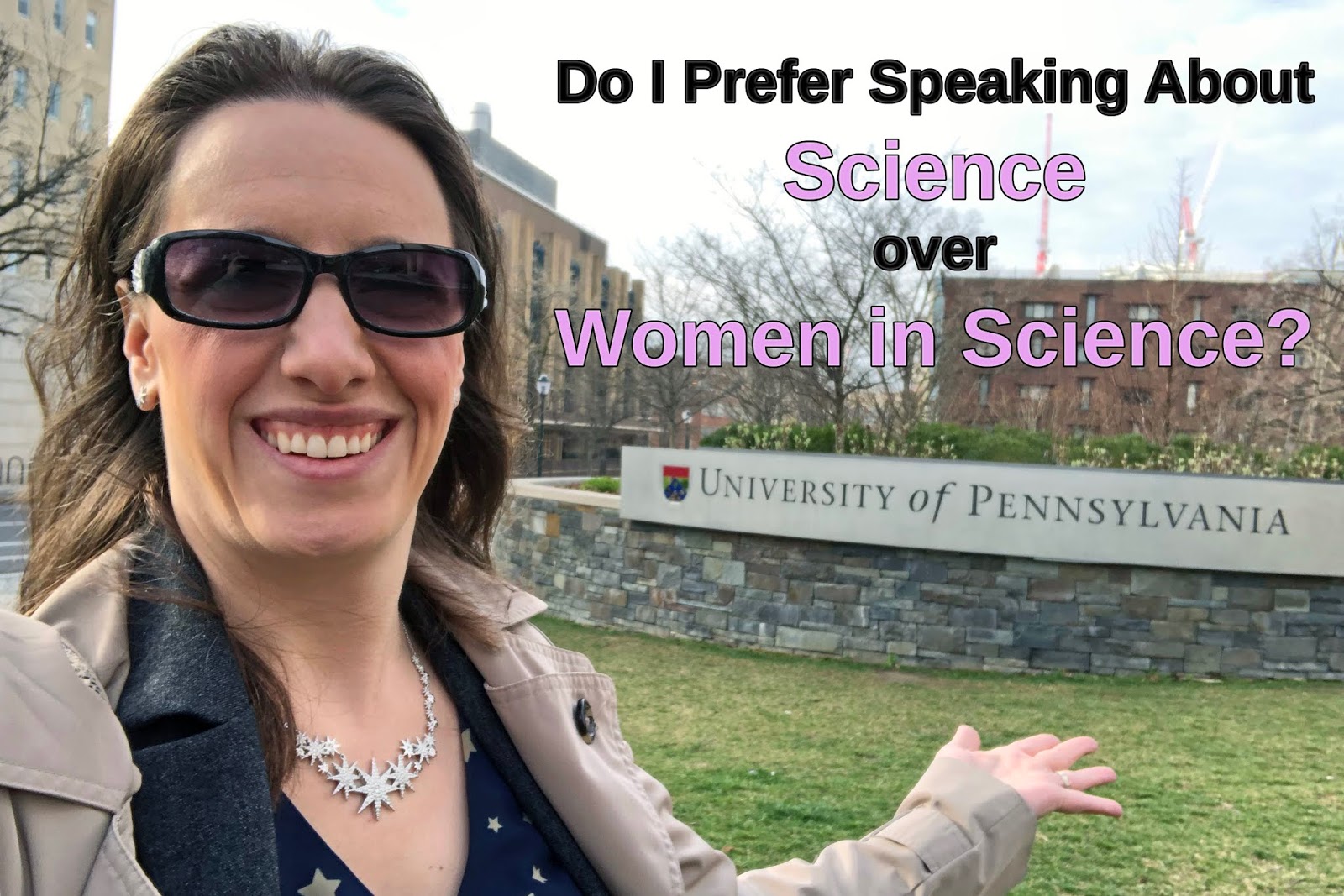
Do I Prefer Speaking about Science over Women in Science?

Presenting at the Ivy Space Coalition, April 6, 2019


“Would you prefer speaking about science over women in science?”

The question was posed to me at the the Ivy Space Coalition conference two weeks ago immediately before giving a keynote talk on women in STEM. I knew the answer, but the question surprised me and I didn’t know how to articulate it. I had been invited to speak about women in STEM and I had written a passionate speech about my own experiences as well as the experiences of other underrecognized women in space. I was gearing myself up to give the talk and was determined to do an excellent job.

But yes, I would prefer speaking about science. I wish I didn’t have to speak about women in science as a separate category from all people in science. But that’s not the world we live in.

I used to believe the categorization set us apart and contributed to the problem. I used to get annoyed at the focus on minorities, believing that if we stop separating everyone out, minorities wouldn’t face as much discrimination. Yes, I used to be so naive.

As a teenager and undergraduate student, I did not see or recognize sexual discrimination in science or in the workplace. As a white person, I did not experience racism, so I didn’t understand the focus on race relations. It was only by maturing that I began to understand the focus on minorities wasn’t causing discrimination, it was recognizing and speaking about discrimination that already exist.

Pretending something doesn’t exist and refusing to put words to a problem doesn’t make the problem go away. As a woman in science, discrimination against women affects me whether I recognize it or not. And thanks to inappropriate and unfair behaviors of a few, it’s now impossible for me not to recognize it in my own experiences,

Over the past few years as I’ve grown in my career and become more independent, I’ve grown bolder in speaking out about sexual discrimination and lack of diversity in the space sector. I focus my efforts on supporting women (especially young women) and calling out the lack of representation when I see it. This has attracted attention, including negative attention by those who preferred the status quo. But I will not be silenced. I will only speak louder to counter the voices of negativity and oppression that still exist in our society.

This is why I was chosen to give the keynote address on women in STEM at the Ivy Space Coalition. This is why I happily accepted. This is why I poured my heart out into a speech which revealed personal details of my experiences and made me vulnerable in front of strangers.

But do I prefer to speak about women in STEM? No. I want to talk about space. I want to discuss my vision of moving humanity closer to the heavens and exploring the mysteries of our Universe. I want to explain my analyses of the space industry and speak about my expertise in planetary science, human spaceflight, and space policy.

But I am a woman and I will always be judged for being a woman. And so I will happily add my voice to the discussion about being a woman in STEM and lift up the voices of other women. I will continue to speak until our collective voices become so loud they echo among the cosmos forever and can no longer be ignored.

Friday, March 1, 2019

Georgia Aerospace Day: Space Policy Fun Among the Chaos of the Golden Dome


Yesterday was Georgia Aerospace Day, the annual event dedicated to advocating for aerospace activities in Georgia at the state capitol in Atlanta. Given my interest and experience in space policy, I jumped at the chance to be involved.

Prior to the event, I organized our team. At one point we had 16 people committed to representing Georgia Space Alliance – not bad for a first-time involvement of a new group! Thankfully that number dropped down to a more manageable team size. I am hoping to expand the team next year. By then we'll have more experienced people to assist in leading.

I wrote up the talking points for the take-away flyer. We weren't advocating for specific legislation, so we kept it broad. Most of the aerospace activity in Georgia is aviation-related, so I focused on informing readers of the space activities and parties in the state. We exist and we do cool stuff and here's why it matters.

I contacted the offices of around 30 members of the state Senate and House of Representatives on key committees and the elected officials of members of our team – lots of phone calls and emails! By the end I had appointments with 26 legislators, 6 at specific times and the other 20 to be paged from the chambers' floors while the chambers were in session. Little did I know what that meant.

Our first meeting of the morning was in a representative's office. Unfortunately he couldn't make it, though I did chat with his staff while we were waiting. The second meeting had a scheduled time, but unfortunately the meet-up plan was to page him from the House Chamber floor. So that didn't happen as planned.

The Georgia Space Alliance team holding up our take-away flyers
It was such a contrast to be speaking about forward-thinking 21st century technology relying on 17th century methods. In order to page a member from the floor, we needed to fill out a slip of paper, wait in a long line for 15 to 45 minutes, hand the slip of paper to a woman who hands it to a teenage page (ages ranging from 12 to 18) who tries to find the legislator at their desk but may or may not know what the legislator looks like, then wait until the page returns or the legislator appears at the ropes. Our group filled out 15 to 20 slips (one per person per turn in line) and had one member successfully paged. It's a ridiculously outdated and inefficient system that wasted our entire morning, time we could have spent visiting legislators' offices and talking to their staff.

Our team standing in line for forever to page legislators from the floor.
We did manage to speak with one additional representative and one senator from the ropes. A member of our group recognized a senator from a previous interaction, and while greeting her, explained why we were there. She was kind to indulge us.

I used modern technology to meet with my state congressman: social media. After unsuccessfully waiting in line for 35 minutes to page my rep and having the page not find him, I tweeted my thanks and tagged him. He responded. A few more back-and-forths on Twitter and he found me on the ropes before I had even gotten through the line for the third time.

I have no idea why pages aren't electronic messages sent to members instantly, or at least sent to an aide to approve and then sent to the members. That would not only be quick and easy, it would be much more productive and reduce wasted time by orders of magnitude. Instead of wasting an hour to page a legislator at a high failure rate, it could be done in a minute! One thing is for sure: I will never page a member of congress from the floor using human pages again. Lesson learned.

Our final meeting with multiple legislators was also canceled as members chose to go directly to lunch instead of meeting with us in their office. All told, we met with one state senator, two state representatives, and a few staff members in various offices. Thank you to those who took the time to speak with our small group on such a busy day! Lesson learned #2: visit congress first thing in the legislative year or after crossover day when they're not so busy.

Heading towards the main Georgia Aerospace Day event.
We regrouped and ate at the nearby cafeteria, then geared up for the second event of the day: the networking event and expo in the capitol rotunda. When we arrived back, several companies and organizations had set up booths and banners to promote their aerospace (mainly aviation) business. There were speeches by the event organizer, the Lt. Governor, and the Governor. Those remaining of our team met with Governor Kemp for a photo after his speech.

Photo op with the Governor
The networking event gave me a chance to have some useful conversations with existing colleagues and meet new ones. I'm particularly excited about a new space education project I learned about. I had fun with 3D printed prototypes at one table and 360 degree augmented virtual reality at another table. Plus these events are great for fun “swag” take-away items. Georgia Space Alliance didn't have a table this year but I'm already thinking of possibilities for next year.

Thank you to our Georgia Space Alliance team!