Friday, April 29, 2016

Next Generation Inspired by Next-generation Suborbital Researchers Conference

A decade ago as a senior just before graduating with my bachelor's degree, I attended my first conference. I've been loving conferences ever since. But my absolute favorite is the Next-generation Suborbital Researchers Conference (NSRC). I've been to every NSRC ever held thus far. I'm delighted that the streak continues and I'll be attending this year's NSRC in Broomfield, Colorado from June 2 – 4. I'm so excited I can hardly wait!

NSRC began in 2010 in Boulder, Colorado. I was a graduate student in my second month at a new university pursuing my doctorate in planetary science. My grad advisor, Josh Colwell, was one of the organizers of the conference along with Alan Stern, the man of many hats. Attendance exceeded expectations. Speakers included Lori Garver, Pete Worden, George Nield, Jeff Greason, and Rick Searfoss. SpaceX, Virgin Galactic, Blue Origin, XCOR, and Masten were present, among others. Research topics included spectroscopy, solar observations, vulcanoids, suborbital observatories, and regolith dynamics.

Posing with Virgin Galactic's model spaceplane. - NSRC 2010

Being so new to the commercial space industry, I really felt inspired by NSRC. This conference came at an important time for me, right after President Obama's FY2011 budget request and the cancellation of the Constellation program when I felt hopeless about the future of spaceflight. I wrote, “This conference gave me a true sense of belonging among people such as these. I feel like the doors are open to me wider than I realized before. I am very optimistic about my future and the future of the space industry. The dream is still alive!”

I was personally involved in NSRC 2011, hosted by my advisor Josh at my university in Orlando, Florida. I was the volunteer coordinator, recruiting and organizing 40 student volunteers helping to make the conference happen. I was even interviewed by a local news station.

Spreading the love of space on TV - NSRC 2011

This second conference was just as magical as the first. I wrote, “I remember feeling this way during the first NSRC last year in Boulder: energized, passionate, enthusiastic, optimistic, and grateful. All of those feelings came flooding back to me today at the start of NSRC 2011.” Speakers not already mentioned included George Whitesides, Robert Braun, Frank DiBello, David McBride, David Masten, Keith Cowing, and Eric Seedhouse. Even more microgravity research was presented than the year before.

NSRC 2012 was in Palo Alto, California. It was there that I met Neil Armstrong after his talk about suborbital spaceflight history. I am forever grateful that I got to shake his hand before he was gone! XCOR gave away a free Lynx ride to a lucky winner. Speakers not already mentioned included June Scobee Rodgers, Andrew Nelson, William Pomerantz, Carissa Christensen, Rand Simberg, and Jeff Foust. One thing that struck me was the diversity of microgravity research presented compared to previous years. So much science!

Meeting Neil Armstrong, first man on the Moon - NSRC 2012
Prototype future spacesuit helmet - NSRC 2012


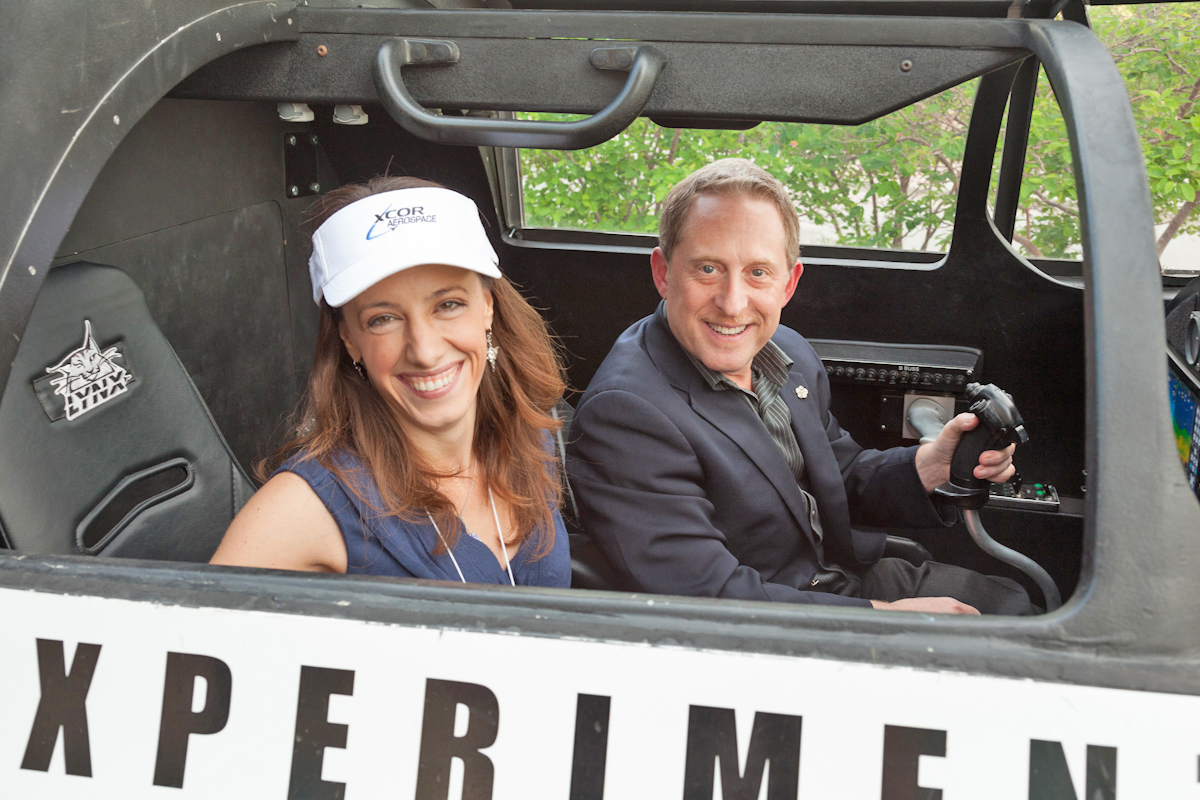
NSRC 2013 was back in Colorado, this time Broomfield just outside of Boulder. One of the first things I did upon arriving was climb into a lifesize model of the XCOR Lynx and pretend to fly. I had just started my new job at the Center for the Advancement of Science in Space three months prior and I gave my first public CASIS talk at the conference. Speakers not previously mentioned included Charlie Walker, Mike Lopez-Alegria, Scott Parazynski, Stu Witt, Wayne Hale, Mike Suffredini, Mark Sirangelo, and Jane Poynter.

Flying the XCOR Lynx - NSRC 2013
Where will Alan Stern fly us to in this Lynx ride among the stars? - NSRC 2013


I raced my friend Ryan Kobrick in assembling Lego Lynx models (he won, just barely). I sang Queen's Bohemian Rhapsody with a table full of inebriated professionals. I stayed up really, really late chatting about space with other like-minded dreamers. I wrote, “I really can't believe that all of this is happening to me. NSRC is the best conference ever.”

Legos! - NSRC 2013

And now, NSRC is back after a 3 year hiatus! Originally planned to be an every-18-months conference from 2012 onward, the fifth NSRC was delayed until enough progress in the industry justified the meeting. I'm looking forward to hearing from researchers, flight providers, and everyone else involved! Speakers not previously mentioned include Alan Eustace, Steve Jurczyk, David Miller, John Olson, Jason Reimuller, and Steve Collicott. I'm looking forward to seeing old colleagues and meeting news ones!

And what's sure to convince everyone that I'm crazy, I'll be attending with a baby. This will be a challenge, for sure, but I'm up for it!


For more information, visit http://nsrc.swri.org

Thursday, April 28, 2016

Take My Kid to Work, and to Work-Related Play, Every Day

Today is Take Your Kid to Work Day in the United States, and unofficial day originally created to expose girls to the workforce. As a work-at-home mom, every day is Take My Kid to Work Day for me. And I do take Josephine everywhere – meetings, networking events, science fairs, even workshops and conferences. Even if I worked outside of the home, I'd still take her with me to work from time to time, no special day needed.

I was invited to a space networking reception yesterday at Exploration Tower in Cape Canaveral. It began at 5:00 and my husband wasn't even home from work yet, so I took my baby with me. I still don't know if or how many people may judge me for bringing a baby to a professional event, but at this stage of my life, I just don't care. My baby is well behaved and people love her. She's a natural conversation starter and ice breaker. To date, no one has said anything negative to me about bringing my baby along, but many people have been grateful I did. One other person did bring their kid with them, but she's college-aged!

Mommy and baby at the reception - April 27, 2016

Josephine met her fourth astronaut yesterday, the Director of NASA's Kennedy Space Center, Bob Cabana. He immediately took her in his arms and cuddled with her, calling himself the baby whisperer. His eyes shone as he talked about his upcoming visit to see his grandchildren. It was so sweet.

Astronaut #4 on Josephine's list: the baby whisperer. - April 27,2016

Unfortunately, no one told me that there would be a very, very long stretch of talking and presentations in the middle of this party! First the reception host spoke. Then Bob Cabana spoke about the workforce at KSC and NASA's Journey to Mars. Then KSC's Director of Planning and Development spoke. Then one, possibly two other people spoke. My baby can be quiet, but not for that long. I eventually had to take her to the next room where we bonded with the catering staff. Josephine had a giggling fit that apparently could be heard in the next room – oops – but no one minded, I was told.

Floor time near the wall before it got crowded. - April 27, 2016

Josephine eventually fell asleep on my shoulder as I wrapped up networking and said my goodbyes. As someone who works from home, it's nice to get out and about to see my colleagues and meet new acquaintances. And so long as I can, I'll take my child with me.

Friday, April 15, 2016

People First, Then Money, Then the Universe

Something difficult has been on my mind lately and I want to put it out there. I don’t want to seem bitter in writing about a negative topic. My intention isn’t to complain, but to spread awareness. In our society, the human element in the workplace can be lost. People’s feelings can be overlooked. Sometimes management needs to pause to consider the people the who company is responsible for by employing.

Since moving back to Florida six years ago, I’ve had a string of jobs that I wouldn’t return to. In all of the positions, I loved the missions and my role in them. I’ve also had a couple really good bosses who I looked to as mentors. But the employers/companies/institutions I worked for left bad impressions ranging from not so good to lawsuit-worthy bad. I don’t know why my luck seems to be so poor. And to clarify, I love my career and I love being part of the space community in Florida!

In the months before and after the birth of my daughter, as my previous position was coming to a close, I looked for other full-time opportunities and even applied to a couple. Even my experiences as an applicant were negative. I’m not an entitled millennial; I’m talking about decent common courtesy such as responding to communication and being honest. If a company can’t treat a potential employee well when they’re trying to woo her, then how will they treat an employee they already have?

Years ago when I used to watch the Suze Orman Show, I admired one of her catchphrases: People first (then money, then things). The financial guru gave advice about money, jobs, spending, and financial planning, but always made sure that the needs of people came before all other. It’s one of the two greatest commandments in Christianity – love your neighbor as yourself. It’s the golden rule we teach our children – treat others as you want to be treated. It seems that many employers have lost this basic tenant.

I stopped seeking full-time employment a couple of months ago when I realized that I was much happier working for myself. Working with individual clients gives me the ability to create and build relationships that remind us that we are people first. It also gives me the freedom to drop a client if I feel that integrity is absent.

A general plea to those in positions of authority and responsibility out there, in any field: Remember why we’re doing what we do. Remember who we’re doing it for. Remember the people who are making you and your company a success. Your greatest and most difficult job as a boss is to serve your employees.

It doesn’t matter how much we accomplish in space exploration and development or what kind of world-changing scientific discoveries we make if we forget that people are the reason why we do it all.

Friday, April 8, 2016

Baby Josephine Congratulates SpaceX!

One more excited and adorable entry today: Baby Josephine congratulates SpaceX on a successful launch, landing, and Dragon deployment to the International Space Station. And congratulations to Bigelow Aerospace for finally launching the Bigelow Expandable Activity Module (BEAM)!

Josephine's a little distracted during the launch. - April 8, 2016

Adding cuteness to your launch experience. - April 8, 2016

As for my close-up launch shots, I need to learn how to properly use my new telephoto lens. A night launch and a day launch have been foiled by my inexperience with it so far! I'll shoot the next one.


Baby at the Science Fair

For the third year, I was honored to return to my undergraduate alma mater, Florida Institute of Technology in Melbourne, to judge the space sciences senior projects. Some of these students have been working on their research for just a semester, while others have been learning and refining their project over the course of their undergraduate career. I love meeting the students and learning about their research, which does change from year to year!

I was really rushed in recording my vlog at the event, so I want to summarize the projects here. The nine that I learned about from the students' mouths today were (in the numerical order they were assigned):

The Small Extreme-Contrast Ratio Imaging Telescope which uses the charge injection device (CID) technology that I learned about when evaluating International Space Station science proposals. (A CID was approved to fly on ISS, currently scheduled for June.)

A look at the closest and brightest quasar's quirky jet as seen from the Hubble Space Telescope in optical and X-ray.

A look at why cosmic rays hitting Earth aren't isotropic but instead concentrated in one area of the sky, as seen by two neutrino detectors.

A model to understand the planetary orbital resonances of exoplanets observed by Kepler.

A model to understand the spectroscopy (energy emitted) of regolith (dirt) on planetary bodies without atmospheres, including asteroids, with a particular look at porosity (how densely packed or how many holes there are in the grains). This is one of the many steps in a project I've been assisting with.

An examination of protein fiber growth that returned from flying on the ISS, another project I learned about when I did ISS research evaluation. It was nice to learn about the results of that experiment!

A look at the magnetic field of a massive O-type star as seen from a telescope in Hawaii.

Scale testing of the mirror deployment of the James Webb Space Telescope which should launch in 2018. Got to make sure those mirrors deploy perfectly in space!

A model to understand three-body resonances in exoplanetary systems as observed by Kepler.

My co-judge, baby Josephine, was with me this year. This would be her third time on Florida Tech's campus. We attended the Showcase reception together last night. She was also on the campus of the University of Central Florida in Orlando with me yesterday. We visited the Center for Microgravity Research, my former lab, the group responsible for the payload that flew on Blue Origin recently. Baby Josephine will continue her university tour later this month when we visit Embry-Riddle Aeronautical University in Daytona Beach.

Josephine and I at UCF visiting my former lab - April 7, 2016

Josephine and I posing with the panther at FIT - April 7, 2016

My co-judge squirming out of her wrap at the Science & Engineering Showcase at FIT - April 8, 2016

Saturday, April 2, 2016

COLLIDE-ing Suborbital Science with Blue Origin

I usually don’t blog on the weekend. I’m usually at the ice skating rink at this time on a Saturday. But amazing feats of science and engineering don’t limit themselves to weekday work hours. Right now, I’m geeking out to the latest successful launch and landing by private rocket company Blue Origin!

After I earned my master’s degree in high-energy astrophysics in Huntsville, I switched over to “experimental planetary science” (my phrasing) at the University of Central Florida with Dr. Josh Colwell as my advisor.

Josh was working on a number of projects, but one that caught my attention was the study of how space and planetary dust (regolith) interact at very low velocities. When the grains or clumps collide, do they stick together, bounce, break apart, or what? Most of what could do in the lab in 1 g (Earth’s gravity) was even faster than we wanted to observe. We built a drop tower in the lab to examine our experiment in microgravity, but our short tower only allowed less than a second of free fall. We wanted more. I flew on two parabolic aircraft campaigns with Josh to gain a few more seconds of microgravity per parabola. But still, we wanted more.

Josh had flown an experiment on orbit on the International Space Station, COLLIDE, Collisions Into Dust Experiment. He was preparing another version of COLLIDE to fly suborbitally on a Blue Origin experimental rocket. I was intrigued by the partnership with an emerging commercial space company. For my first year and a half in the lab, I participated in teleconferences with Blue and worked on preparing the experiment for launch. The engineering students on our team did most of the work, but I was pleased and excited to participate in any way I could.

A COLLIDE box in foreground, the original COLLIDE in background, and me recording something. - February 2011

But in 2011, Blue Origin’s test rocket malfunctioned and was destroyed. Our chance to fly COLLIDE with Blue was postponed indefinitely. We were all disappointed, but that’s the way it works in the space industry. This stuff is hard and set-backs happen.

I’ve been out-of-the-loop with the experiment since leaving UCF. But yesterday, I heard the exciting news that COLLIDE would launch soon. And this morning, it did just that. Blue Origin’s rocket New Shepard launch and landed successfully in Texas.

We’re all currently awaiting the release of the official video of the successful test. I’m awaiting news of how my grad school team’s experiment fared. Knowing first-hand just how tricky those experiment boxes can be, I’m crossing fingers and hoping for the best.

The official Blue Origin COLLIDE video can be seen here:


I will update this entry with the official Blue Origin rocket video once it’s published. But first, ice skating.


Thursday, March 31, 2016

Selling Cookies & Cupcakes for NASA Planetary Exploration

April 2012, four years ago, a professor of mine approached me with an opportunity: would I be interested in running the Orlando location of the national Planetary Exploration Car Wash and Bake Sale being organized by Alan Stern (of Pluto/New Horizons fame)? I laughed so hard at the concept, I had to say yes. Sounded like a blast!

In January, the presidential administration issued its FY2013 budget request which projected a significant decrease in NASA’s planetary science funding over the course of five years starting in FY2013. The planetary science community was up in arms to organize and combat these cuts in Congress.

It was understood that the car wash and bake sale was a publicity stunt. In no way could anyone make up the cut NASA funds in local community fundraising. The idea was to use the event as a platform to increase attention to the issue and to gather large groups of people to write letters to Congress in support of planetary science.

I coordinated with other locations running similar car washes and bake sales via regular teleconferences. I had met Alan before, but I had never worked directly with him until this point. I remember being very impressed with his organization and leadership style. Most meetings are run inefficiently, but Alan made the planning of the event easy and fun.

Not so easy on my end was bringing in more people to help me. I recruited a fellow student to assist with public relations. A few professors and other students were on board to help with the set-up and staffing of the event. But I carried the torch and it was heavier than I anticipated. It was even difficult to secure a location! Once I realized that local participation was going to be low, I axed the idea of running a car wash powered by volunteers and shifted to hosting a bake sale at a car wash location.

A day before the event, publicity exploded. News organizations from all over were asking for quotes. I got a call from CNN’s sister network Headline News (HLN) to be interviewed. A bakery in New Jersey wanted to donate and overnight us baked goods. My public relations helper was overwhelmed. We were able to get a few articles published with quotes, but it was such a whirlwind I can’t tell you how many or where.

I managed to get in touch Alan to let him know about the HLN interview. He was able to call in audio-only while I went into the studio in Orlando for the interview. I have a recording of the interview on CD but I haven’t watched it since it happened and couldn’t tell you what they asked. My standard line was, “We’re not asking for more of the pie; we’re asking for less of a bite out of the pie.”

HLN interview - June 8, 2012

The Orlando Planetary Exploration Bake Sale occurred on June 9 in conjunction with other such events around the nation. We arranged the baked goods on the tables and gave them themed names. Thanks to NASA KSC’s public affairs office, we had NASA meatball stickers, exploration posters, and pretty images of the planets all over. We had form letters for people to sign that we would send to Congress. Our humble event looked great!

Admiring our display - June 9, 2012

In the end, we collected just enough money in donations to cover the cost of the purchased baked goods and postage. We sent approximately 275 letters to key members of Congress. A couple news camera came to cover the event. Our little publicity stunt was a success!

Can I offer you a cookie? - June 9, 2012

NASA’s planetary science budget has been in great shape ever since. The United States has the most successful planetary exploration track record in the world. With the success of missions such as New Horizons, hopefully our nation will continue to invest in our planetary exploration missions.

Monday, March 28, 2016

The Best and Worst Proposals I Saw When I Reviewed For a Living

My main responsibility when I worked at the Center for the Advancement of Science in Space (CASIS) was to evaluate the merit of International Space Station utilization proposals. I did this day in and day out with a variety of proposal types ranging from big money to no money, pure research science to technology demonstration, academic to commercial. Some proposals I evaluated myself, some as a team, and some with a panel of subject matter experts.

It didn’t take long to figure out what separated a good proposal from a bad proposal. Here are some tips for the proposal writers out there:

1. Follow the Instructions

We’re taught this in preschool, yet some professionals still don’t get it. The worst proposals (aside from the crackpots which were at least entertaining) were the ones that did not follow the guidelines. Unless that proposal had connections, it was immediately placed in the “needs to be reworked” pile if not outright rejected. One proposer refused to submit anything except titles and one-paragraph descriptions and there was nothing we could do with those. We really tried to give constructive feedback to those who submitted incomplete proposals on how they could improve or what they needed to add. What we said was already in the instructions.

The best proposals were the ones that literally copied and pasted the evaluation questions in their proposal (available in the instructions) and answered each one of them in detail. When an evaluation sheet asks the reviewer, “How does this proposal justify the use of the ISS?” and the proposal writer has two paragraphs under the heading, “Justifications for the use of the ISS,” evaluation is simple. If the instructions say to include these budget figures, include them. Everyone’s life is simpler when the instructions are written clearly and followed well.

2. Proofread

Reading through your writing to look for errors and to improve wording is another basic skill that we’re taught in primary school. Yet for whatever reason, maybe due to busy schedules or cockiness, professionals don’t always follow this step. One of the worst proposals I ever read was clearly a combination of a few previous proposals that had been copied and pasted into a new proposal. The fonts didn’t match, the document didn’t flow, and the whole idea didn’t make sense as it was written. If the proposal writer had taken the time to read through her document, she would have seen the glaring errors, at least two per page by my count.

A proposal is a professional document to try to convince others that the proposer is competent enough to complete the proposed task and that the task is worth doing. Submitting a poorly proofed proposal does not look good for the competency and professionalism of the proposer, no matter how worthy the task is.

A well written, well proofed, concise proposal is a rare prize. Such a shiny proposal is easy to read, easy on the eyes of the reviewer, and perhaps even a pleasure for the reviewer to read. A happy reviewer doesn’t guarantee a favorable outcome, but it helps.

3. Consider your audience.

Proposals submitted through a scientific review process, as described in the instructions, are evaluated by scientists. There were more than a few proposals written by businesses for business professionals submitted through our scientific process. Scientists call this business material fluff and it wastes our time. It also fills pages and wastes space that could be filled with scientific information that would strengthen a proposal. Taking out the marketing material, the proposal is left with very little content to evaluate. A lean proposal with little meat is not likely to be approved.

I’ve also evaluated business plan proposals for a previous job as a space industry analysis. Business plans evaluated by industry experts should be written differently than scientific proposals. It is okay to assume that the reviewer knows who the big aerospace players are without explanation. It is not okay to misspell the names of those big aerospace players. Business plans without basics like how the company intends to make a profit will leave reviewers rolling their eyes. In-depth technical information about the product doesn’t belong unless the instructions ask for it. I have scientific knowledge as well as industry knowledge, but I’m unusual. Don’t assume everyone knows the specific area of science you do.

In short, leave the marketing and MBA information out of scientific proposals. Include business information and exclude deep technical information (unless asked) in business plan proposals. Remember who your audience is.

Friday, March 25, 2016

Sciencing It Up with Baby at the Business Table

I'm beginning to be a little more open about something I've mostly kept quiet about: I work at home with my baby. This may not be surprising if know that my baby is young, just 3 months old. My two-week maternity leave coincided with the Christmas and New Year holidays, and I've been working part-time ever since. I'm no stranger to working at home. I worked at home in my previously job and only drove into the office when it made sense to. I love working from home and feel that I'm more productive and happier here than in an office environment. Plus, it's a big money saver: no daycare costs, no commute, and no office lease. It's not for everyone, but it is for me.

With one exception that I've already already written about, I separate myself from my baby when I attend professional gatherings. Any time I've gone out as a professional for a meeting, workshop, or lecture, I leave the baby at home. Thankfully, my husband also has the freedom to work from home occasionally. Part-time daycare doesn't exist here and we haven't interviewed any babysitters yet, so we've been fortunate that either one or the other of us can watch the baby during working hours.

Yesterday, it just so happened that a meeting I had was at the same time as back-to-back meetings my husband had. My choices were to either cancel or take her with me. I strapped her in the car and brought her along for the ride. Josephine's first science meeting!

I can understand the disruption that some babies might cause. There might be screaming so loud and continuous such that conversation is futile. There might be banging of toys or shaking of rattles. There might be babbling. There might be smells.

At this time, my baby is pretty easy-going. When I wrap her to me, she discretely eats and sleeps. When she's unwrapped, she looks about and stares. She might start softly complaining, but I can quiet her pretty easily now (until 10 PM when she's overly tired and just won't sleep). The biggest disturbance she causes is just by being cute and drawing the attention of those around her.

The meeting yesterday at my alma mater, Florida Institute of Technology, was productive. University faculty and students met with NASA Kennedy Space Center scientists and myself in an effort to move forward with a Martian regolith biochemistry experiment. We got to check out the huge vacuum chamber that NASA KSC gifted the university, currently being refurbished. Martian regolith simulant will be processed in Martian atmospheric conditions. Separate temperature and humidity controlled containers will house crop experiments in the Martian simulant soil. It'll be fun!

Florida Institute of Technology's NASA vacuum chamber, in progress - March 24, 2016

A decade ago, I walked those halls carrying a backpack filled with science books, notes, and dreams. Yesterday, I walked those halls carrying a baby, a bit of science expertise, and even bigger dreams. How times change!

For her part, Josephine did just great on her first trip to a college campus. She was quiet, attentive, and only had one moment of projectile spit-up as we were heading for the elevators. I'm grateful that the colleagues I met with yesterday were so understanding and welcoming of a baby.

I'm hoping that I can continue to take the baby with me to professional meetings and gatherings as circumstances allow. I remember my mom the lawyer taking me with her to her office and to court when I was young. If I can do that, if I can to set an example and help change mindsets, maybe the business culture will change. Women who feel that they must disappear from their professions for months after a baby is born will either avoid those professions or avoid becoming mothers. If I can do both, so can others.

Baby Josephine says, "Fly me to the Moon, and let me play among the stars." - March 18, 2016

Tuesday, March 22, 2016

A Look at NASA Human Spaceflight Over the Years - My First Report!


Space social media was buzzing about NASA Administrator Charles Bolden's State of NASA address on February 9, shortly after President Obama released his administration's FY2017 budget request. Curious before the release, I read up on the 2015 State of NASA speech. I was curious as to how NASA's priorities had shifted over the years through the annual speeches. However, the speeches were a fairly recent idea. In years before, NASA administrators were called into congressional hearings to answer questions about the proposed NASA budget.

The more I looked, the more I curious I got about how priories had shifted over the years. I knew that humans to Mars had been a goal since the Apollo days, but I hadn't realized that humans to an asteroid wasn't a new idea either. It was interesting to see how what NASA planned and valued through the speeches and congressional hearings. NASA Administrator Sean O'Keefe had a totally different focus than his successor Michael Griffin. Charlie Bolden's focus hasn't turned out to be all that different from Mike Griffin's. It makes me wonder what the next presidential administration and NASA administration will focus on.

Also catching my interest were the reactions in Congress. Certain members of Congress championed certain programs and criticized others. Some even changed their minds over the years. Although I had been under the assumption that opinions would coincide with party lines, the data showed a much more bipartisan approach to NASA program funding. Not surprisingly, location had more to do with how a member of Congress supported or opposed a program or budget that would benefit or hurt their constituents.

All in all, I looked at nearly 80 documents over the past 15 years, focusing on human spaceflight. The scope of my attention was limited because I had to call the report done at some point. But I believe my choices were comprehensive and offer a lot of detail. I'm proud of my work and excited to release my first report on Astralytical: NASA HumanSpaceflight Evolution 2001 – 2016.

Check out this graphic and explanation in the report!


Friday, March 18, 2016

Hey Space Millennials – Want to Be in a Book?

I hadn't intended to write a book. The idea popped into my head one evening. Curious, I ran the idea past my space community sounding board, Twitter. The response I've gotten has been surprising! Within days I had several interviews lined up, some of which I'm already examining the answers.

Rise of the Space Age Millennials (working title) will explore the views and attitudes of the next generation of space leaders. Those born between 1981 – 2000 are entering the workforce and rising to positions of responsibility and action within the space science and space industry. How do those of my generation feel about the promise of future space achievements? What motivates them? How do they differ from their older colleagues? And what about those millennial stereotypes – are these inaccurate generalizations or do these traits affect the way in which we work and progress space efforts?

Questions to millennials include:

What excites you about current space programs?
What space destinations should humans travel to?
Would you support another Apollo-like mission?
How important is mission length? What about multi-generational missions?
How important is safety? What are your feelings on risk?
What will millennials accomplish in the space industry?

In forming the interview questions, I thought about what I'd want to know if I were the reader. This is my generation, but I can only speak for myself and the conversations I've had with my peers. With a larger pool of data, I can see trends emerging. Or, conversely, explore the diversity of opinions.

I'm aiming for the book to be out by the end of the year. I've never written a book before, so I could be kidding myself. Advice in book writing and publishing would be appreciated.

Are you a millennial or do you know a millennial working in the space community who might be a good fit for this book? If so, please contact me to be on the Millennial Panel.


Click here to watch the vlog: Adventures in Book Writing.

Tuesday, March 8, 2016

Progress Happening at NASA KSC with Center Director Bob Cabana

NASA KSC Director Bob Cabana at National Space Club - March 8, 2016

Every year, the National Space Club Florida Committee is honored to hear from NASA Kennedy Space Center Director Bob Cabana, also a former astronaut (STS-41, STS-53, STS-65, and STS-88). Today he was back at the luncheon at Cape Canaveral to give us an update on KSC!

No official NASA talk would be complete with the obligatory Journey to Mars mention and chart. Bob didn't harp on it. Instead, he dove right into the meat of his presentation: upgrades and progress at KSC. The big push here over the past few years has been including commercial industry and making infrastructure modifications to become a multi-user spaceport.

One of the exciting pieces of space hardware I got to see last year was the Orion crew capsule for Exploration Mission EM-1 in the O&C building's high bay being worked on by Lockheed Martin. Orion is officially scheduled to launch in fall 2018, but will likely slip. In addition to mentioning Orion, Bob also talked about SpaceX's Dragon crew capsule and Boeing's CST-100 Starliner crew capsule, both currently scheduled for launch in 2017.

Bob also spoke up modifications to the mobile launcher and the crawler transporter. After modifications, this will be the crawler transporter for the next 30 years, he said. He also mentioned that modifications to the Space Launch System (SLS)'s launch pad 39B have been completed. Because SLS is only scheduled to launch at the most once per year, they are seeking additional users for that pad.

Although there are more ULA and SpaceX launches scheduled at the Cape in the next few months, the next NASA Launch Services mission isn't until the Origins, Spectral Interpretation, Resource Identification, Security, Regolith Explorer (OSIRIS-Rex) launches on an Atlas V, currently expected to be in September. I'm excited about this robotic probe mission which will bring back a sample from a carbonaceous asteroid!

NASA and Space Florida recently signed an agreement for Phase B of Exploration Park. For those unfamiliar, the only building currently in Exploration Park is the Space Life Sciences Laboratory (SLSL) where I've coincidentally worked in for three previous jobs or projects. In Phase B, Blue Origin will build a manufacturing plant for its reusable rockets. I was surprised to learn how big this facility will be! According to Bob, it will be seven stories tall and have a bigger footprint than the huge Vehicle Assembly Building (VAB) at KSC.

Bob spoke a bit about the workforce drop-off after the space shuttle program ended. KSC's NASA workforce is currently stable and predicted to remain approximately constant so long as budgets are relatively constant. He gave an anecdotal story about NASA losing employees to private industry which is ramping up right now.

National Space Club luncheons are always a fun place to catch up with colleagues. Where else can I show off baby photos (the launch photos in my previous blog entry) to the KSC Director, a U.S. Congressman, and so many other space enthusiasts in the room? Bob also graciously gave me a little bit of his time for a 30 second interview (see below): What is your favorite thing happening at KSC in the coming year? Check it out!


Friday, March 4, 2016

Space Baby Congratulates SpaceX on Another Successful Launch


Faith in the Stars, Science in the Vatican

On to a controversial topic that isn't politics – religion! I very rarely mention my faith in professional circles because it's not usually relevant. Science and religion has been on my list of potential blog topics since the creation of this blog a year ago. Reflecting on the astronomy and faith talk I attended on Wednesday inspired me to finally “come out of the closet,” to use Brother Guy's phrase. I've been subject to prejudice and harassment about my faith by classmates, professors, colleagues, and even strangers since college. The amount of intolerance of honest and informed differences of opinion and differences of belief are astounding in such an enlightened age. I've grown a pretty thick skin.

Science and religion have never been at odds with each other, in my opinion. I'll never understand why we in modern times pit them against each other in a false dichotomy. They address two different areas of our universe: science the what/where/when/how, religion/theology/spirituality the who/why. Religion flows flawlessly with science/reason. Science/reason never disproves religion. It can't. They operate on different plains.

“God created the Universe. The Universe is worthy of study. Science is an act of worship.” - Bother Guy Consolmagno

The beauty and the wonder of the Universe is why I was inspired to study astrophysics. And to become an astronaut, of course. But there are many paths to being an astronaut. The stars called to me as young as elementary school. I wanted to learn all about this awe-inspiring creation.

I was raised Christian and converted to Catholicism when I was 25 and in graduate school. I treated my conversion process as the scientist I am: systematically studying the data and weighing the evidence before coming to a conclusion. Perhaps because of my adult conversion and my upbringing, I'm far more open-minded about spiritual journeys than many. Each person's path is their own, one right for them, and it's not for me to judge or claim mine is better than any other.

I was excited to drive up to Embry-Riddle Aeronautical University in Daytona Beach on Wednesday evening for a talk with Br. Guy, a Jesuit with a PhD in planetary science from MIT who now serves as the Director of the Vatican Observatory. Joining him was the university chaplain Rev. David Keck and radio show host Marc Bernier who I had worked with previously on local spaceport issues. I knew Br. Guy from my early days at the University of Central Florida where one of my graduate school planetary science classmates was also a Jesuit brother, but it had been several years since I had heard him give a talk.

Br. Guy started off discussing two fallacies that some use in the science versus religion debate. The first, a false wall between reason and faith. People are whole; we don't compartmentalize well. We don't turn off our brains on Sundays. We don't ignore reason when thinking about religion. We also don't put aside our faiths when we consider science. The two work together well and don't need to be separated.

The second fallacy he mentioned was about science and faith just being about facts. Neither are. Science is a process of discovery where we constantly test ideas, are proven wrong, and learn something new. Religion is a process of understanding God, who we are, and the world we live in. For example, Genesis isn't a history book. The creation story in Genesis isn't meant to be taken as a collection of historical facts (according to Catholic teaching; others may disagree). It's a moral book. There is always more to discover about science. There is always more to discover about theology.

I always smile when people wonder if the Big Bang contradicts Catholic teaching on creation. Those people don't know their science history. Georges Lemaitre, a Catholic priest also with a PhD from MIT, developed the theory of the Big Bang. At the time, people mocked it because they thought it promoted the existence of God, not contradicted it!

What about creation or evolution? “Yes,” Br. Guy responded. “Evolution is description of how God creates.” Evidence of the acceptance of evolution can be found in the writings of Saint Augustine of Hippo, a bishop, who lived 354 – 430 AD!

Upon thinking of the science and human society lecture I attended last week by a “skeptic,” I was surprised when Br. Guy addressed other points of view. “Religions need atheists, agnostics, and skeptics. They keep us honest. We're all searching for the truth,” he said. “All humans and only human look at the stars in wonder. Something within us desires something in Heaven and the heavens.”

"Cosmology, Science, and Faith With Brother Consolmagno and Rev. David Keck" - March 2, 2016

Wednesday, March 2, 2016

Imagining A Mission to Jupiter's Ganymede with Planetary Science Summer School

Group shot - PSSS Session 1 - July 2010

The application deadline for the NASA Planetary Science Summer School at the Jet Propulsion Laboratory in Pasadena, California is approaching, and I realized that I hadn't yet written about my own PSSS experience six years ago. Rereading our paper and looking at photos just now, I remembered that I had met a few of my friends and colleagues through that experience. I present to you:

Ganymede Interior, Surface, and Magnetometer Orbiter, or, GISMO.


Planetary Science Summer School is a one-week bootcamp. Fourteen of us planetary science and engineering graduate students and post-docs gathered for the first session of PSSS in July 2010. We had been emailing back and forth for a month or so, throwing around ideas and getting to know each other. It was through these exchanges that we settled on our mission to Ganymede, Jupiter's largest moon and the only moon known to have its own magnetosphere (magnetic field).

I was assigned the positions of Planetary Protection (protecting other worlds from us) and Education & Public Outreach (EPO). I was tasked with creating our protocols and objectives for protecting Ganymede and nearby worlds such as Europa from contamination and educating the public, especially students.

Protecting the solar system from us humans - July 2010

Additionally, I chose to be on the non-icy surfaces team and the instruments team. On the non-icy surface team, we focused and advocated for studying the interesting surface and subsurface features that Ganymede has to offer, that aren't ice. On the instruments team, we determined which sensors we'd need to carry in order to complete our science objectives. We had to make difficult choices when we didn't have enough money, didn't have enough data bandwidth downlink, didn't have enough power, or was too heavy to carry all that we wanted to fly.

What impressed me the most about the experience was how quickly we were able to design a planetary exploration mission to another world. With the help of experts from JPL's Team X, in just a week, we wrote a mission design paper and an hour-long presentation with technical details and budgets in line with a NASA New Frontiers program mission. The science objectives of the GISMO probe were to study:
  • the magnetic field
  • the interior
  • the surface
  • the atmosphere
All for approximately $710 million.

This was my first time at JPL, so I was glad we also got to see the sights. We got a tour of the Mars Exploration Rover mission (Spirit and Opportunity) facilities including rover mock-ups, testbeds, and the controls that give the rovers their schedule. We saw the Mars Science Laboratory Curiosity in the clean room before it was launched. It was nice to roam the campus-like grounds, including spending time with the deer. We even saw a show at the Hollywood Bowl, BBC's Planet Earth with the Los Angeles Philharmonic.

Me with a Mars rover mock-up - July 2010

Mars rover testbed - July 2010

Curiosity on a test run in the JPL cleanroom before its stroll on Mars - July 2010

In addition to our NASA presentation that week, we also presented our paper at the Lunar and Planetary Science Conference, the American Astronomical Society's Division for Planetary Science Conference, the American Geophysical Union conference, and the Institute for Electrical and Electronics Engineers' Aerospace conference. If there ever is a NASA mission to Ganymede in the future, I hope that the creators of that mission build upon what we started with GISMO.