Monday, August 15, 2016

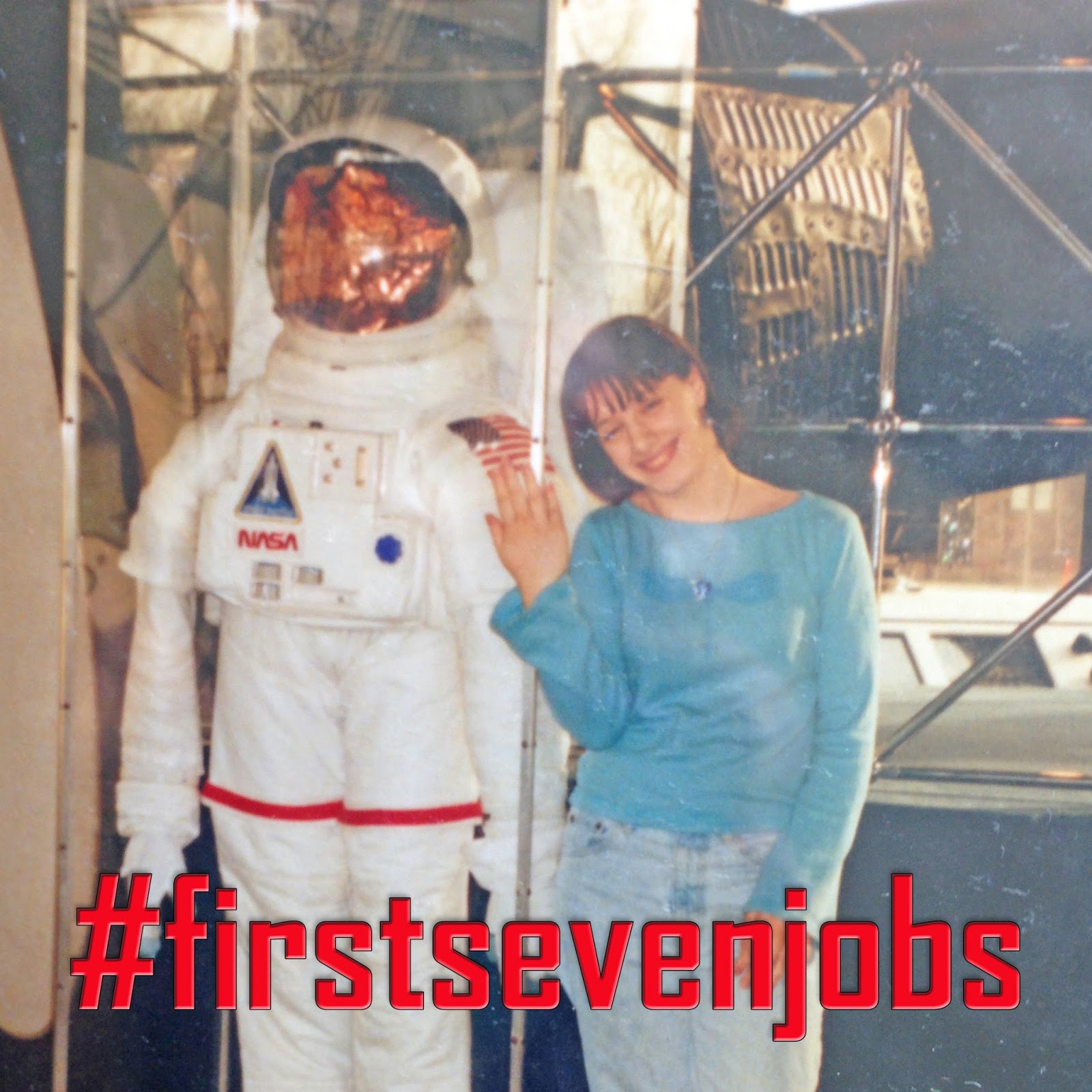
#firstsevenjobs

Even at 16, I was focused on space!

It has been over a month since my last catch-up blog entry. What a crazy month it has been! I started my new position at Northern Sky Research, which I'll write about later because it's awesome. Moving, selling a house, and buying a house have been enormously time-consuming. I am pleased to report that our Florida home is on the market and we're in contract to move into our new home north of Columbus, Ohio in a month. In the meantime, we're living in a hotel room. All of us. My husband, our crawling-and-cruising baby, three cats, a dog, and fish. Life is an adventure.

Recently, there was a trending Twitter hashtag (with variants): #firstsevenjobs. I've always found people's journeys fascinating. I had to really think about my life, where I started and how far I've come, in order to write my first seven jobs progression. It's difficult to remember life as a 16-year-old just starting out making minimum wage. A high school student with dreams, plans, and potential! It seemed that each job represented another step in my journey, another chapter in my life.

It was just as interesting to read others' journeys, posted in fewer than 140 characters. Some posters, early in their careers, shine potential and hope. Others, later in their careers, embody calm satisfaction with where they are. Surprisingly, some successful careers took fewer than 7 jobs to achieve, especially military careers. Great for them! Some successful careers were preceded by so many lower-level jobs that 7 wasn't enough to paint a picture of success. But they got there. Or they will.

The diversity of paths is what fascinates me the most. Everyone's first seven jobs were completely different and mostly unpredictable. We do a disservice to kids by implying they must choose their careers young and not diverge from their (or someone else's) chosen path. No one's path is straight and plan-able. But we all end up going somewhere.

From an early age, I fell in love with space and decided that what I wanted to dedicate myself to. But that's not a job title nor a job path. I had to feel my way through it. In high school, I felt lost, not knowing how to get there or who to ask. Authority figures were supportive but just as unknowing. We all knew college was a good place to start!

Even before college, I had a first job: babysitter. Based on my high school circle, I would have thought babysitting was a common first job. This doesn't seem to be the case based on what others tweeted. I had brief side gigs selling things and tutoring, but for the most part, I watched other people's kids. I babysat under-the-table, then obtained my first official job at age 16 in childcare at the local YMCA making minimum wage.

I'm grateful to the professors and administration at my undergraduate university emphasizing the importance of internships and career-relevant experience. The summer after my freshman year of college, I sought my first astronomy internship. I had no idea how to get one. With cold calling, I obtained a volunteering astronomy research position while also obtaining my second official job: selling shoes in a mall department store for minimum wage plus commission. I was terrible at it. Thankfully, my volunteer position ended up being paid, leading to job #3 and my first career-related job at age 19: astronomy research assistant.

I'm so very grateful to the professors who gave me a chance. Many people's third jobs aren't positions related to their intended career. This position led to every other step and success in my career. Without this starting point, I wouldn't be where I am today. From them, I learned about scientific research, programming, data analysis, and technical writing. I was officially a scientist-in-training.

I returned to that job for a second summer, but not before beginning job #4: student newspaper editor-in-chief. I've held numerous volunteer position, including some career-related, that I don't consider to be official jobs. After a year of voluntarily serving as news editor, I was paid (minimally) to lead the student newspaper for two years. It was a time-consuming, thankless job, but I learned quite a bit about communication, language, marketing, and layout. And I was "banned from NASA for life" - ha!

I landed my first NASA internship at Marshall Space Flight Center during the summer after my junior year. Job #5 had a similar title as job #3: astrophysics research associate. I spent a second summer with that same position before transitioning from intern to graduate research assistant, job #8. But not before taking on job #6: grader for a freshman physics class. During that summer between undergraduate and graduate school, I also helped run the internship program as an assistant operations manager, job #7. The summer ended and grad school began.

From high school babysitter to astrophysics graduate student in seven jobs and six years. That's a long way! In the following decade, I've become a chemical engineer, a planetary science graduate research assistant, a space industry analyst, a scientific research analyst for International Space Station payloads, a regional operations manager for a space start-up, a high school tutor, and an independent space analyst and scientist.

By my count, I'm up to jobs #15 and #16 (simultaneously). And I provide full-time childcare for my infant, but I'm not paid for that. Sixteen paid positions, and I'm still early/mid career! Insert millennial joke here.

Each person's path is unique. Very rarely is it straight and predictable. Very rarely do first (or second or third) jobs indicate someone's career path or potential. From the start I had a goal – space – but not everyone does. And that's okay. We keep on trying, keep on going, keep on reaching and exploring. I'm looking forward to seeing where my journey takes me.

How's your career journey going?

Wednesday, July 6, 2016

New Jobs, New City, New Adventures!


I've been mum on my life's happenings recently. Now that it's all settled, I'm going to share with you what's going on. Comments and suggestions welcome!


STEM & Social Media Outreach

As someone guilty of taking on too much at once, I'm pleased to have I wrapped up two projects. At the start of June, my favorite conference returned from a three-year hiatus: the Next-generation Suborbital Researchers Conference. I ran social media for the conference activities. I wish it wasn't over because I had a blast, but I'll be back next year.

I spent some time assisting Benignant STEM Innovation Foundation, a nonprofit dedicated to educating students, especially girls, in developing countries and underserved areas. So inspirational! There are many potential opportunities for grants, fundraising, partnerships, collaborations, and projects for a new STEM nonprofit. The process can be daunting. I helped to point them on the right path.


Commercial Spaceflight Federation

I've been searching for a new space organization “home” for a few years now. When I attended the CSF spring members meeting last year, I felt it! But my former employer's membership dissolved along with its existence. I didn't let that stop me! I'm excited to be working with CSF again in whatever small ways I can. Right now I'm helping them identify sponsors and prepare for an upcoming FAA AST conference.

New Client

Starting Monday, I'll be an analyst for a new client. I love how global this company is, with colleagues around the world providing different perspectives. My first project will be a cool (and hot!) topic to start with! I'll write up a more detailed blog entry once I start work.

Science

One of my biggest professional mistakes this year has been relying on others to conduct science. As a result, I waited and waited, and still haven't gotten my hands dirty. Either projects were delayed or I simply wasn't included. This is a poor way to do science collaboration. I decided to take matters into my own hands. I finally allowed myself time to brainstorm science recently, and an idea came to me.

How I wish I could tell you about the proposal I'm writing via Astralytical! I read an article explaining that science bloggers are hesitant to write about their unpublished work because they fear being scooped. I can tell you that's true. It's related to my expertise in planetary regolith and it touches upon human space habitation in a way I haven't seen before. I still need to complete a literature review to put this experiment in context. I may reach out to potential collaborators, but on my own terms.

Book Writing

I wrapped up the millennial panel interview process last month! But Adventures in Book Writing is on hold for now because I'm crazy busy and there's no deadline. Sorry! I'll get back to it by the end of the summer for sure.

Ohio, Here I Come

Coincidentally, my husband has been going through a job search as well. He just accepted a position at JP Morgan Chase in Columbus, Ohio. I've never even been to Ohio, but I grew up in the Philadelphia area of Pennsylvania, so I'm familiar with four seasons. We'll be moving within the month.

This is so bittersweet for me. I love Florida! I love living in this area so much that I moved here for undergrad, moved away to Huntsville, then moved back. I love the warm weather and the lack of snow and “real” winters. I love the beach, the water, the greenery, and the wildlife. I love the rocket launches and the space happenings. I love my friends and close-by family. I love the space community I've built here. It's going to be very hard for me to leave!

Glenn Research Center is one of the few NASA centers I've never been to, and it's only two hours from Columbus. Ohio State University is gigantic and has not only a physics department, but also an astronomy department, a cosmology & astroparticle department, and a planetarium, so I may find like-minded researchers and enthusiasts there. Ohio Aerospace Institute seems to be a smaller equivalent to Space Florida. I'll find my space peeps in Ohio, somewhere.

Friday, July 1, 2016

Sparklers & Rocket Launches

My husband holding the sparks

My husband and I were playing with sparklers last night in anticipation of the American Independence Day. Being the scientist I am, I immediately wondered about the shapes, colors, and chemical reactions of sparklers. I was able to find out a lot of information about the chemistry of these simple fireworks, which is so interesting! But I'm a physicist, I want to understand the physics.

In general, sparks are created when a strong electric field accelerates free electrons, creating ions and freeing more electrons. This creates an electrically conductive area, allowing for a sudden flow of electricity. However, this is not the kind of sparks that sparklers create.

Pyrotechnics, fire caused by chemical reactions, is what fuels sparkler fun. Sparklers burn metallic fuel explosively, producing branching sparks. Common sparkler fuels include aluminium, magnesium, magnalium, iron, titanium, and ferrotitanium. I don't understand the physics of the branching process and I was unable to find a resource describing it. If anyone reading this knows more, please comment below!

Fireworks are fascinating and beautiful, but fireworks of a bigger kind are even better. I'm still learning how to use my new telephoto lens, but I still managed to capture the powerful fireworks below. Happy birthday, America!

SpaceX Falcon 9 launch on May 27, 2016

SpaceX Falcon 9 launch on June 15, 2016

ULA Atlas V launch on June 24, 2016

Wednesday, June 29, 2016

Juno's Journey to Jupiter


Jupiter is the largest planet in our solar system and the planet most responsible for our current planetary orbits and orders. I once coded a model of our solar system that included and then removed Jupiter, and what a difference! Jupiter keeps everyone in line. My favorite feature of Jupiter is its colorful cloudy atmosphere with huge, long-lasting storms. Seven space missions over the course of 43 years thus far have contributed to our knowledge of this gas giant.

Nearly 5 years ago: August 3, 2011. I was on the guest list for the Juno launch to Jupiter on a ULA Atlas V rocket out of Cape Canaveral. As local planetary scientists and members of the American Astronomical Society's Division for Planetary Science, my graduate advisor Josh and I were invited to participate despite having no direct connection to the mission. I do love living in Florida!

The festivities began with an evening welcome reception. Visitors from all over joined in to mingle and feast. The next day, I enjoyed a tour of Kennedy Space Center. Even though I had toured KSC facilities before, it's always fun to see the new happenings!

The first stop was the International Space Station Processing Facility. It's a large high bay of ISS module pieces, similar to the ISS training mock-up displays that I once saw at Johnson Space Center, but larger. We saw one of the Italian Multi-Purpose Logistics Modules named Raffaello, a docking hub, and a payload canister the same size as the space shuttle payload bay. There was also an early mock-up of the Boeing crew capsule, the CST-100 Starliner.


Raffaello - August 4, 2011

An early Starliner mock-up - August 4, 2011

The next stop was the Vehicle Assembly Building. It doesn't matter how many times I've been in the VAB, its sheer massiveness takes my breath away each time. Parked inside, I was so excited to see space shuttle orbiter Discovery, slightly disassembled, done with its space-flying lifetime and preparing to be a museum piece at the Smithsonian Air & Space Museum in Dulles. Seeing it up close and uncovered was amazing! But I almost teared up, because seeing a retired space shuttle like that is heartbreaking.

Retired Discovery in the VAB - August 4, 2011

Finally, the tour bus took us to the Air Force Station side of Cape Canaveral to the Atlas V rocket sitting on the launch pad with the Juno spacecraft tucked inside, waiting to be launched. I've never been that close to an active rocket. It was really cool! We went around the back first, then after the ULA safety officials deemed it okay, we drove around to the front. It's remarkable how little structure there was for the rocket compared to the huge rotating service structure that used to surround the space shuttles on the pad, which is what I was most used to seeing at the time. In comparison, the Atlas V looks so simple and uncluttered. It was beautiful!

Atlas V on the pad - August 4, 2011

Posing with the rocket - August 4, 2011

Bright and early on the morning of Friday, August 5, I arrived at the designated hotel to catch the KSC bus. When pulling into the hotel's parking lot looking for a parking spot while trying to get around the buses, I nearly ran over a man picking up his car at the hotel entrance. It was Charlie Bolden, the NASA Administrator!

We were taken to the Operational Support Building II (OSB-II) near the Vehicle Assembly Building to watch the launch from the fifth floor terrace, a location I had never seen a launch from before. Just prior to the morning briefing, I got a chance to meet Charlie Bolden and get a picture with him. He laughed when I apologized about nearly running him over. The briefing was pretty basic, just a general overview of the Juno spacecraft and mission as well as inspirational and good vibe messages of support. The head of the Italian Space Agency was there as well as a lot of other foreign delegates.

Meeting Charlie Bolden - August 5, 2011

After the briefing, we went outside on the terrace to wait. It was so hot out! We sat in the shade when we could, but that only helped a little. After they kept announcing countdown holds because of various problems (a ground helium leak and a boat in the restricted waters), we went back inside to cool off. Once the countdown resumed, we got a good spot at the balcony. I counted down the last ten seconds. It was so cool to see an Atlas V rocket launch from that close! I was surprised that the rocket lifted off so quickly compared to space shuttles. That rocket in particular has a lot of thrust, but the weight of the payload is light so it can get to Jupiter in a reasonable amount of time.

Juno lift-off! - August 5, 2011

Juno on its way to Jupiter - August 5, 2011

Next week, on July 4, 2016, Juno will “arrive” at Jupiter at long last. Congratulations to the Juno mission team, the scientists who are awaiting this data, and the ULA team that launched it safely there!

Tuesday, June 21, 2016

Impostor Syndrome: When Grad Advisor Relationship Goes Wrong


I’ve just passed a difficult anniversary. Seven years ago, my graduate advisor gave me the curse of science impostor syndrome. A student’s graduate advisor is meant to be a mentor, a trusted authority guiding the young trainee from student to professional. Instead, she crushed me.

Feeling inadequate and an intellectual fraud among superiors is common among women in the sciences. I already had it. But to be told by my advisor that she doesn’t think science motivates me. To be told that she doesn’t think I want to be a research scientist, she thinks I like the idea of being a research scientist. To dismiss my little voice saying, “Yes it does,” and “Yes I do,” as if she could see right through me to my true nature. To be told that I should find a new advisor because I wasn’t as married to research as she was. She devalued me and my chosen career path.

My first graduate advisor is a force to be reckoned with in her subfield. She is well-respected and highly honored. She wins top awards. She’s going to leave a legacy. Someday, someone will name an equation or astrophysical model after her. A widow without children, she was married to her work. She lived and breathed it. Her career defined her life and her life was defined by her career.

I was a student in my mid 20s, passionate about astronomy and space broadly. I’ve never been a specialist, too interested in everything to devote myself to one thing for long. I loved my graduate research, but I also loved so many other things. Since junior year of undergraduate, I’d dedicated myself to the study of our subfield. It was fascinating and challenging, probing the unknown with space telescopes observing the Universe in multiple wavelengths. I learned so much. I spent hours in the lab every day, running models, coding, and plotting (graphs, not schemes). When I wasn’t working on research, I was studying doctoral-level physics textbooks and doing complex homework. I was all in.

But I also had a life. I had no interest in winning the Nobel Prize or scoring a tenured professorship at an Ivy League. I had interests outside of the lab and textbooks. I had a social life. I was converting religions. I wanted to someday marry and have children. The world was open to me. I wanted it all. I didn’t see any reason why I couldn’t have it all.

By definition, a graduate research assistantship is half time. Ask any graduate student whether they work 20 hours per week and they’ll laugh at you. I never recorded my hours, but I was much closer to full-time on a regular basis. When times got tough, grad school took over my waking hours. At times I struggled to maintain a healthy balance.

When my graduate advisor ordered me to drop all of my hobbies and work in the lab from early morning to late evening and weekends, I fought back. I know my limits. That kind of schedule would have burned me out quickly. Plus, it wasn’t necessary. There was no deadline to meet or urgency in our work. She simply wanted 100% devotion. Anything less, and I wasn’t worthy. She even scolded me for attending a physics guest lecture outside of our subfield.

At this point, I was done with my graduate coursework, straight As except for one B in quantum mechanics. I had passed the insanely difficult exam that proved I knew my physics. I had been researching this subfield for 4 years. I should have been fairly close to finishing my PhD – just another year or so to write papers, publish, and defend. She insisted that I was 3 years away from finishing, dismissing all my previous work.

I felt trapped. I felt like an indentured servant. I had won a NASA graduate fellowship, my own grant money, but it was tied to her. She reminded me that she had paid my previous years, approximately $20k per year, plus healthcare. Her goal was to train an apprentice, the next generation of her. She expected me to be her mini clone. She even had my post-doc location picked out, a university overseas, as if I should have any say in the matter. I should be grateful and work harder. Why wasn’t I grateful? Why was I avoiding her?

A year prior, before she lost my trust, I confided in her that I had career interests in other areas. She was wise and experienced; I had hoped for advice. Instead, I was reprimanded. I quickly learned that I could not have an honest career discussion with a woman entrusted to guide my young career.

I tried to improve in her eyes. I tried to be a model student researcher. I gave it my best shot. It wasn’t good enough. I was told that I needed to be obsessed with work. I was told that if I had any plans to work beyond our subfield in the future, I needed to find a new advisor. It was her way or the highway.

She asked me why I wanted a Ph.D. I said it was because I love my research. She said no, I love the idea of my research, I love the idea of being a research scientist. Can you imagine telling a 10-year-old girl this? “You don’t really want to be a scientist, little girl, you just think you do. Go pursue a career more suited for you.” I may have been in my mid 20s, but her condescension made me feel like a confused little girl.

I chose the highway. And I never looked back. I found a fantastic graduate advisor at another university. I have a successful career in the space industry spanning multiple disciplines. I’m writing proposals to be a principal investigator in my own research. I’m married with a family. I have hobbies and interests outside of my career. Success is the best revenge.

But she planted doubt in my mind for a long time. Was I really good enough to be a scientist? Was I dedicated enough to succeed? Am I really meant to be a scientist, or do I just like the idea of being a scientist? The question itself is nonsensical because I was a scientist long before I went to school for it. It’s who I am at the core. And yet the doubt persists.

The damage was done. Impostor syndrome is why I tolerated a workplace bully in my new graduate lab, a jealous lab manager who mocked my research progress. Impostor syndrome is why I’m still hung up on the fact that I left my PhD program ABD, despite being just as competent at physics as any physics PhD. Impostor syndrome is why I let colleagues at my first full-time job treat me as if I was fresh-out undergrad instead of respecting my well-educated scientific opinions at the level they deserved. Impostor syndrome is why I still let some academics get to me when they insist that I need to go back to school to finish my PhD in order to be equal to them.

Impostor syndrome still haunts me. I hesitate to take certain risks or pursue certain opportunities because of it. And in the back of my head, a little voice asks, “Do I really want to be a scientist, or do I just like the idea of it? Do I really want to be a space industry analyst, or do I just like the idea of it?” Never mind that I’m living and doing both. I keep fighting it. I’ll likely be fighting it until the end of my career.

The advisor/student relationship is one of the most important factors in a grad school success. If it goes wrong, get out of there – fast! Leaving my NASA fellowship and university was a tough decision, but it was the right thing to do. I’m better off for it.


Tuesday, June 14, 2016

Frank DiBello's Vision for Florida at the National Space Club


“Florida is hot!” That is how Frank DiBello, Space Florida’s President and CEO, started his annual update at today’s National Space Club luncheon. And he’s not kidding. My phone app gave a temperature of 90 degrees as I left the talk this afternoon but my car thermometer read 97 degrees – and it’s not even summer yet! “And not just because of our weather,” he continued. The aerospace market in Florida is hot.

Although technology failed us when he attempt to show this promotional tourism video, he got the point across: space is important to Florida’s past, present, and future.


A lot of Frank’s talking points were familiar: Florida has a talented workforce, space infrastructure, and a great history of achievement. The Cape Canaveral Spaceport (Kennedy Space Center and the Cape Canaveral Air Force Station combined) is a jewel of the state. There’s no denying that so many in the space business (such as myself) love working in Florida.

Frank discussed some of Space Florida’s big recent successes: the Shuttle Landing Facility (SLF) hand-over from NASA to Space Florida, Blue Origin’s decision to launch and manufacture at the Cape, the OneWeb and Airbus decision to open a factory here. So many big news items, so little time to discuss them all in detail!

Frank’s main focus was the future. Ever since 1989 when the state created Florida Space Authority, Space Florida’s predecessor organization, the state’s goal has been to attract and retain space business. Space Florida’s goal is to become a global leader in space, but there is and always will be competition. “The marketplace can and will speak with its feet,” Frank warned, as he has in the past. But joyfully he added, “ And many are speaking with their feet by coming here.”

Frank spoke of his vision for Florida’s spaceport in 2025 (a bit of an arbitrary date, generally meaning “the future”). His vision is to create an independent spaceport authority to handle routine launches and is tailored to handle commerce. Federal institutions such as NASA and the DoD have their charters. But with academic and private sectors, the space industry will grow. He emphasized that this agency may not be Space Florida; it may be a federal, state, or quasi-government agency.

To assist with the evolution of the Cape Canaveral Spaceport, Frank plans to create a Commercial Industry Task Force to assess whether Space Florida is truly achieving the goal they’ve set for being global leader. At this time, he didn't have a lot of details to reveal about this task force, just the general idea that there's work to be done.

Work that needs to be done, for example: space infrastructure is being modernized and continues to be upgraded. Right now, there is a capacity problem in nitrogen and helium pipelines at the Cape. ULA and SpaceX both require use of these pipelines. If one user needs it, another user must wait. Businesses shouldn’t have to wait on their competition. There's also old, outdated infrastructure. Every piece of infrastructure needs to have a function or create revenue, or it will be disposed of.


“Our job as a spaceflight authority is to think outside the fence,” Frank joked. Within the Q&A, he wrapped up by advocating that we support Space Florida’s efforts by advocating for NASA and DoD programs and budgets. It’s hard to do long range planning with short term politics that are questioned every few years.

Frank and I may disagree in regards to the need for NASA’s Space Launch System and Orion for programmatic and political stability, but I agree with his desire for sustainability and long-term planning. Florida has come a long way since the retirement of the Space Shuttle program five years ago and will continue to grow as NASA, DoD, and private industry make long-term plans and continue to do them.

This is how baby Josephine and I do NSC luncheons - in style! - June 14, 2016

Thursday, June 9, 2016

What I Learned Taking a Baby to a Professional Conference (Part 2)


I took 5-month-old Josephine to an informal professional networking event last night and reminded myself that I still had yet to write about our adventures at an out-of-state conference together last week. Rest and catch-up are top priorities after returning from travel. Now I can reflect on the positive and negative of bringing a baby to a professional conference.

Working and playing, as well as we can together.

Community Support


I had a lot of fears about being a working mother after I gave birth to my daughter and it became clear that she was too young to be away from me for long. I worried that I would be seen as less than professional if I brought her with me. I expected negative or inappropriate comments. I would not have been surprised if people had asked me to leave when they saw me with a baby. Babies don't belong in work environments, right?

My fears were the furthest from the truth. Every time I brought my baby, I was welcomed with open arms. Colleagues and new acquaintances loved meeting her and watching her grow. Young women and older men thanked me for bringing her. Only once was I asked not to attend a meeting with her, a rare exception to the warm welcome she's received. She's an instant star no matter where I go. The one downside is that on occasion, colleagues are more interested in talking about her than about business!

The way I saw it, I could either bring my baby with me or stay home, out of sight. Bringing her to one day of the local Space Congress was a test. Taking her on a plane to Colorado, without my husband, for a 3-day conference to the Next-generation Suborbital Researchers Conference in Broomfield, Colorado was the real deal! How would she behave? How would others react? Would I be able to attend the conference talks at all?

I was overwhelmed with the generosity, encouragement, and support from the conference staff and attendees! From the moment we arrived, others offered to hold her, play with her, give her toys (conference swag), and take care of her. Conference staff made her a special name badge. She attracted conference attendees like a magnet. One man thanked me for bringing her because her sounds during the talks lessened the seriousness of the atmosphere and reminded him of home and humanity.

Baby Genius - All Star!

The Noise


There's no way around it: babies make noise and there's no quieting them. I knew that I would be in and out of talks. I just hoped that I would be in more than out.

I lucked out with a relatively mellow baby. She doesn't cry all that much, but she does have her moments. She wasn't feeling well on Friday afternoon, so I hid in the bathroom for a long time, hoping the thick doors would dampen her screams. But worse, I didn't have my phone or laptop because I couldn't return to the conference ball room with a screaming baby to retrieve them, my feet were hurting me in brand new dress pumps, and there were no restroom chairs, so I sat barefoot on the floor not even knowing the time while she screamed and screamed. Eventually she did calm down and we reemerged. Aside from that outburst, screaming fits were rare.

More common were little baby grunts from learning to crawl and play and “songs” from learning to use her voice. When those got too loud and persistent, I needed to leave the room. Sometimes I would walk with her along the back wall by the door, leaving when she was loud and returning when she had quieted. In and out, in and out. While this certainly is not an ideal way to hear talks, I was able to pick up bits and pieces of conversation this way.

Most of the time, she was quiet enough for me to be in the room. Especially when she napped in my lap! During those periods, I could focus on the speakers and pretend I was attending a conference as usual. Except that I was in the back of the room sitting on the floor next to toys, usually.

Conference swag makes for good toys.

Baby Wearing


I wore my baby in her wrap less often than I expected to. There were times when it made sense, such as during a tour of a nearby company's facilities where we'd be walking a lot. I opted not to bring a stroller to the airport, instead wearing her around the terminal. However, during the conference talks, mostly we were sitting down. I tried sitting with her in my lap, but she got bored quickly. Instead, I laid a baby blanket on the ground and let her play with toys independent of me as much as possible. Outside of talks, she would be passed from person to person so much that it didn't make sense to attach her to me. I'm glad I brought the wrap and I did use it frequently, but she wasn't attached to me at all times.

Baby hanging out on the tour.

Hotel Sleeping


I have difficulty sleeping in a strange place. So, it seems, does my baby. We didn't have our normal routine and sleep aids such as her swing, so sleep didn't come as naturally to her. It was a struggle each night to get her to stay asleep. Usually I succeeded an hour or two after her usual bedtime.

I opted not to bring her crib, instead allowing her to sleep in the king-size bed with me. At home, her crib is right next to our king-sized bed so she spend half the night in her bed and inevitably half the night in ours. Co-sleeping works well for us. I didn't even think twice about keeping her in the bed with me while on travel.

Sleeping on my lap.

Brave, Hero and Supermom


I was called all these things for bringing a baby to a conference. I am none of them. I am simply a working mom who loves my career and loves being with my child. I find it interesting that in our culture, we would see this behavior as something to be praised highly with descriptions such as brave, hero, and supermom. In my opinion, this only points to the need to combine maternity and career for new moms and make what I did common.  

Thanks for bringing me along, mom!

Thursday, May 26, 2016

Lessons Learned Attending a Professional Conference with a Baby (Part 1)


I will be writing a separate entry about the science and updates learned from Space Congress in Cape Canaveral this week. But I felt it was important for me to write on this topic first. 

I've never seen a baby at a professional conference before. Prior to having my own baby, it never would have occurred to me that a mother would choose to take her child with her. Now that I have a baby of my own who refuses a bottle, my only choices are to participate in my profession with the baby or not participate at all. Yesterday, I chose to stand out from the crowd.

I didn't know how anyone would react to my presence with the baby. Worst case scenario, I thought I'd be denied entry or asked to leave. Second-worst case, I thought the baby would scream, causing me to miss most of the conference I paid for. I didn't know if anyone would stare at me or make a negative comment about how unprofessional or disruptive it was to bring a baby. I prepared to defend my choice, if necessary.

Fears are usually all in our head. Not only was I welcomed with the baby, I received so many compliments! By the end of the day, at least four people told me that they hadn't heard a peep from her and she was the most well behaved baby they had ever seen. It's not that she didn't make a peep, it's that I contained her well. She kept me on my toes!

I learned a new wrap style for the occasion: outward facing carry. I still wrap her in a sling style when nursing discretely, but my 5-month-old no longer wants to face my chest. She wants to see the world! The outward facing wrap is the most secure wrap style I've learned yet and was truly hands-free. It was perfect for times when I needed to walk around and mingle such as during the talk breaks and exhibit hall networking.

To my surprise, I did not spend all of my time standing and bouncing her along the wall. Instead, I found a back corner away from foot traffic and closest to the bathroom. There I laid out a small blanket and some toys, plugged in my laptop, and sat on the floor to listen and work. It was ideal! I may have looked silly to others, but this really was the best possible arrangement. The baby kept herself well occupied, I could work without holding her or constantly moving her active hands away from my laptop, and we were completely out of the eyesight of all conference attendees except those walking along the back of the room.

Playing with the conference swag on the floor. - May 25, 2016

In retrospect, it was a wise move on my part to wear pants instead of the cute pencil skirt I had wanted to wear. Sitting on the floor with legs in any direction would not have worked well in a skirt or dress. It was also smart of me to wear a cowl neckline.

Listening to the conference speakers uninterrupted only happened when the baby was napping. Unlike a normal day, she only dozed off for short periods of time – no long naps. Applause would wake her, usually just for a moment, but sometimes stirring was enough to snap her out of her slumber. As a result, at no time was I away from my baby and able to attend the conference as a normal professional except when two of the college-aged conference volunteers asked to hold her.

I was able to attend all of the conference talks (except when I stayed in the exhibit hall for too long during a break). Even though I was in and out a lot, I was able to get a lot out of attending. I live tweeted and I took notes. I got the gist of the conversation. I was surprised at how much of the conference I could actually attend.

As someone put it yesterday, a baby and a dog in a crowd have similar outcome: people flock to you for the cuteness. A baby is an effective networking aid. Colleagues and strangers alike approached to meet the baby and, secondarily, me. She was a natural conversation starter. The one negative was that because time was short and the baby was easy to talk about, I didn't talk as much “shop” as I would have liked. Part of that was also the fault of the conference schedule: too few and too short breaks. I had hoped that the 6:00 networking session would make up for it, but by that point, the baby had had enough and it was time to go home.

Josephine on a Journey to Mars. - May 25, 2016

Overall, taking my baby with me to a professional conference was a success. I tear up when I think of how supportive my space community is. So many positive comments and words of encouragement! I want to thank every one of you who helped me to get over my fear of negative judgment and do what works best for us. I feel so blessed to have such beautiful people in my life.

This local conference was practice. The test is next week's three-day out-of-state conference. Stay tuned!

Also, Josephine got to meet her fifth astronaut and take additional photos with ones she had already met. And she went to Mars!

Curious Josephine hanging out with Curiosity rover. - May 25, 2016

Monday, May 23, 2016

Am I Building My Dreams, or Someone Else's?


“If you don't build your dream, someone else will hire you to help them build theirs.”

This quote, attributed to several sources, struck me when I read it last week. I've been going through a period of self-evaluation lately. What am I doing? Where do I want to go? What should I be doing to get there? This quote struck at the heart of my inquiry. What are my dreams, and am I building them or simply helping others to build theirs?

A lot has changed in my life in the past six months. The company I worked for closed its doors. I gave birth to my first child. Naturally, my life has adapted to changes beyond my control. My work has shifted away from a traditional 9-to-5 office job and toward a flexible schedule around my family life. While I've always been a multitasker, I'm even more so now as I balance multiple clients and projects as well as seek new opportunities. I've never been happier, more satisfied, and more at peace with my work-life balance than I am right now.

Am I building my dream, or am I simply for hire to build others' dreams? Does it matter? Can't it be the same thing?

My dream since childhood has been to do work involving space. I especially wanted to be an astronaut! I still do, not a NASA astronaut but instead a private one. The path forward for private spaceflight is still unclear, so I wait and watch for the right opportunity that doesn't cost as much as my house.

As for doing work involving space – check – been doing that for 13 years now. I defy advice to specialize and instead have collected skill sets, experiences, and interests like a hoarder: astronomy, astrophysics, space telescopes, telescope manufacturing, planetary science, experimental dust dynamics, in-situ resource utilization, space industry analysis, space policy, microgravity payloads, ISS operations, physical sciences and technology development research, proposal evaluation and review, parabolic aircraft operations, event planning and promotions, social media and communications, STEM nonprofit education and outreach, and business development. Where do I fit? Everywhere; all if it.

Each job I've had has brought me closer to where I want to be. Each job I've had wasn't a perfect fit and had its flaws, but it gave me experiences, insight, and opportunity to move forward. Each move has helped me to build a great career and bring me to where I am today.

An opportunity was presented to me two weeks ago, another potential path. It was a path from my past, one I rejected but always wondered if I shouldn't have. The opportunity presented seemed too good to be true. And I wanted it. I thought of it as a way to jump back on a path from the past and ride it to wherever it would go. I got my hopes up. But as it almost always is the case, this too good to be true opportunity was too good to be true. Reality was less appealing. In fact, it was a giant step backward. I closed that door once more.

Building my dreams requires me to identify my dreams. I couldn't detail them for you. I have vague notions. I'm pressing ahead with them, defining them as I go.

In truth, I miss science. I don't get to do it much these days, just bits here and there as I consult others. I miss getting my hands dirty. I miss conducting new research that no one else has done before in order to progress our understanding of the world. A well-meaning colleague recently told me that I'm not qualified to do independent research with just a master's degree and ABD on my PhD. I completely disagree, and I find that attitude insulting to the scientists and engineers out there who conduct independent research and move their fields forward without the title Doctor. Of course I can do my own research. Of course I can write and win my own proposals. I just need to identify what I want to pursue first, then go for it.

I have various projects that are of my own creation. I'm writing a book about millennials in the space industry, telling their stories, because it interests me. I've just resurrected the idea of a survey of emerging space (newspace) companies, because it interests me. I'm active in advising and promoting state and national space policy issues, because it interests me. These aren't dreams I'm building. These are tiny building blocks of a dream to normalize space happenings to make it relevant to everyone and anyone.

That is my dream. It's big and it's broad. It requires countless people working on countless projects, big and small. It doesn't have a definite end or time frame. It's wide-reaching and global. It's an honor to help build others' dreams, if their dreams coincide with mine. It's fun, it's exciting, and it helps me to see our mutual dreams in a new light. I love working with clients who can help me to build my dream as I help them to build theirs. It's symbiotic and harmonious. And I've only just begun!

Aside from the financial side, I'm working the best job I've ever had. Will you build your dream with me?

Tuesday, May 17, 2016

Career Sacrifices: No Tours for Me


My nearly 5-month-old refuses to take a bottle. She used to, now she doesn't, preferring to scream and starve if given the option. And in fact she did go on a hunger strike for around 8 hours when I left her with my husband for a day, which is how we made this discovery. Therefore, I cannot be physically apart from my baby for more than 2 hours without feeling exceptionally bad for the adult caring for her (i.e., my husband).

I am given the choice to participate in my profession with my baby or opt out. I've been choosing to participate when I can. I'm just as competent, passionate, and ambitious in my career with my baby as I was before. However, there are limitations to what I can do at the moment. Some plans are on hold. Others are delayed or take more time. And some opportunities, as much as it pains me, must be sacrificed.

I have sacrificed two conferences/meetings this year and was ready to sacrifice a third before I jumped on-board with the planning committee to help out. I love this particular conference, and although I was prepared to miss it, I really didn't want to. So, I committed, with my baby. In 15 days, I'll be on a plane to Denver, traveling with my child and no other adult, determined to make this work during the three-day conference.

I won't be able to participate as widely as I usually do. I'm willing to sacrifice the opportunity to listen to every speaker or to hear every word coming from their mouths. I've already sacrificed the chance to present a poster because it would be too much to handle with the baby. I'm willing to sacrifice networking time if I need to change a diaper instead. I'm prepared to leave for the airport earlier and set aside more time to allow myself to eat. I know I'll sacrifice sleep; that goes without saying for the parent of a young one. And, unfortunately, I'll need to sacrifice special opportunities to see things I may not ever get the chance to see again.

I got excited when I saw the news: a chance to tour Ball Aerospace! Cool! I'm a visual learner. I learn by seeing and by doing. I jump on the chance to take tours, to experience the atmosphere around the work being done, and to ask question after question of the tour leaders. I'm their favorite kind of visitor because I'm engaged, learning, snapping photos (when allowed), tweeting, and getting the word out. I soak it up.

But the baby. How could I take a tour with the baby? They probably wouldn't allow me to bring her because of safety standards or some other policy. What if I need to walk her away from the crowd to calm her down? What if she spits up over their equipment? What if I need to do an emergency diaper change? In a hotel banquet hall, I can take care of her. On a company's secured property, it would be a lot harder. Could I even safely take her on the tour bus without the car seat anchored to the vehicle?

Sadly, I decided to sit that one out. But then, a second tour! This one of Sierra Nevada Corporation's facilities. And oh, how I wanted to go. I thought about it, thinking of how I could make it work. I even started composing an email asking if I could bring her. But the same issues arose again and again in my head. I just can't.

Usually, I'm all about asking forgiveness rather than permission. But in these cases, even I don't think I can justify asking permission. As a working mother, I make sacrifices for my child. This is one of them.


How do other women do it?

Tuesday, May 10, 2016

Space Science Awesomeness at Florida Space Institute and a Reusable Rocket in the Port

Hello pretty reusable rocket stage! - May 10, 2016

I have an internal debate every time. Should I bring my baby to this professional event? Why shouldn't I? But I've never seen anyone else bring a baby. What are my options, aside from skipping the event? Will anyone actually care?

Lately, the debate has been decided by this definitive statement: “I'm about to bring a baby to a conference for three whole days. I need to get over it.”

And so, for the National Space Club's monthly luncheon, I brought my baby along with me. The guest speaker was Ray Lugo, the head of the Florida Space Institute (FSI) which I was sort of under as a graduate student at the University of Central Florida (UCF). I wasn't going to miss his talk about my grad university and colleagues!

Attendees immediately made me feel welcome as I walked through the door with Josephine in my arms. The first person I spoke with, Barry, told me that he was glad I brought her. To my surprise, three people took photos with me and her. Eddie put my unsettled mind at ease, telling me that he brought his kid to events like this when they were little. The man I sat next to even plated my salad and poured my water for me. Thank you, everyone!

She slept while I ate. Then awoke and babbled during the talk! - May 10, 2016

Ray gave an overview of FSI for those unfamiliar. This began with an overview of the professors, all of which I knew and had worked with during my time as a graduate student. Then he went over some of their current research project. First, Josh Colwell and Addie Dove's projects. Strata-1 is a regolith size distribution project launched to the International Space Station. The cubesat experiment Q-PACE is another regolith experiment to study dust dynamics in microgravity, very similar to my grad research. NanoRocks, which had just begun when I was a student, flew on ISS in 2014 with NanoRacks.

Next, Phil Metzger's projects. World is Not Enough (WINE) is a collaboration with Honeybee Robotics to develop an ISS cubesat to test in-situ resource utilization technology such as sample acquisition, volatiles capture, and 3D-printed cold gas thrusters that use water vapor. Phil is also working on developing asteroid simulants and ISRU using clay but the slides moved too quickly for me to read it all.

Ray then discussed some of Dan Britt's projects such as the development of Martian sensors and a mission called Gulliver to conduct Martian moon sample return. He also mentioned an Earth observation cubesat mission and ground-penetrating radar to study asteroids. He concluded his talk by mentioning that UCF may bid to take over the operationsof the Arecibo observatory in Puerto Rico.

Ray Lugo at the National Space Club Florida Committee luncheon - May 10, 2016


Already at Port Canaveral for the talk, I stopped by Milliken's to check out the recovered SpaceX Falcon 9 rocket stage that launch and landed on a ship in the ocean on Friday. I stepped off the sidewalk onto a little dirt path so I could get a shot with the rocks and palm frond. So cool! I love living in Florida.

A space geek, a reusable rocket, and a baby. - May 10, 2016


Thank you, National Space Club Florida Committee, for making this working mom feel welcome.

Friday, April 29, 2016

Next Generation Inspired by Next-generation Suborbital Researchers Conference

A decade ago as a senior just before graduating with my bachelor's degree, I attended my first conference. I've been loving conferences ever since. But my absolute favorite is the Next-generation Suborbital Researchers Conference (NSRC). I've been to every NSRC ever held thus far. I'm delighted that the streak continues and I'll be attending this year's NSRC in Broomfield, Colorado from June 2 – 4. I'm so excited I can hardly wait!

NSRC began in 2010 in Boulder, Colorado. I was a graduate student in my second month at a new university pursuing my doctorate in planetary science. My grad advisor, Josh Colwell, was one of the organizers of the conference along with Alan Stern, the man of many hats. Attendance exceeded expectations. Speakers included Lori Garver, Pete Worden, George Nield, Jeff Greason, and Rick Searfoss. SpaceX, Virgin Galactic, Blue Origin, XCOR, and Masten were present, among others. Research topics included spectroscopy, solar observations, vulcanoids, suborbital observatories, and regolith dynamics.

Posing with Virgin Galactic's model spaceplane. - NSRC 2010

Being so new to the commercial space industry, I really felt inspired by NSRC. This conference came at an important time for me, right after President Obama's FY2011 budget request and the cancellation of the Constellation program when I felt hopeless about the future of spaceflight. I wrote, “This conference gave me a true sense of belonging among people such as these. I feel like the doors are open to me wider than I realized before. I am very optimistic about my future and the future of the space industry. The dream is still alive!”

I was personally involved in NSRC 2011, hosted by my advisor Josh at my university in Orlando, Florida. I was the volunteer coordinator, recruiting and organizing 40 student volunteers helping to make the conference happen. I was even interviewed by a local news station.

Spreading the love of space on TV - NSRC 2011

This second conference was just as magical as the first. I wrote, “I remember feeling this way during the first NSRC last year in Boulder: energized, passionate, enthusiastic, optimistic, and grateful. All of those feelings came flooding back to me today at the start of NSRC 2011.” Speakers not already mentioned included George Whitesides, Robert Braun, Frank DiBello, David McBride, David Masten, Keith Cowing, and Eric Seedhouse. Even more microgravity research was presented than the year before.

NSRC 2012 was in Palo Alto, California. It was there that I met Neil Armstrong after his talk about suborbital spaceflight history. I am forever grateful that I got to shake his hand before he was gone! XCOR gave away a free Lynx ride to a lucky winner. Speakers not already mentioned included June Scobee Rodgers, Andrew Nelson, William Pomerantz, Carissa Christensen, Rand Simberg, and Jeff Foust. One thing that struck me was the diversity of microgravity research presented compared to previous years. So much science!

Meeting Neil Armstrong, first man on the Moon - NSRC 2012
Prototype future spacesuit helmet - NSRC 2012


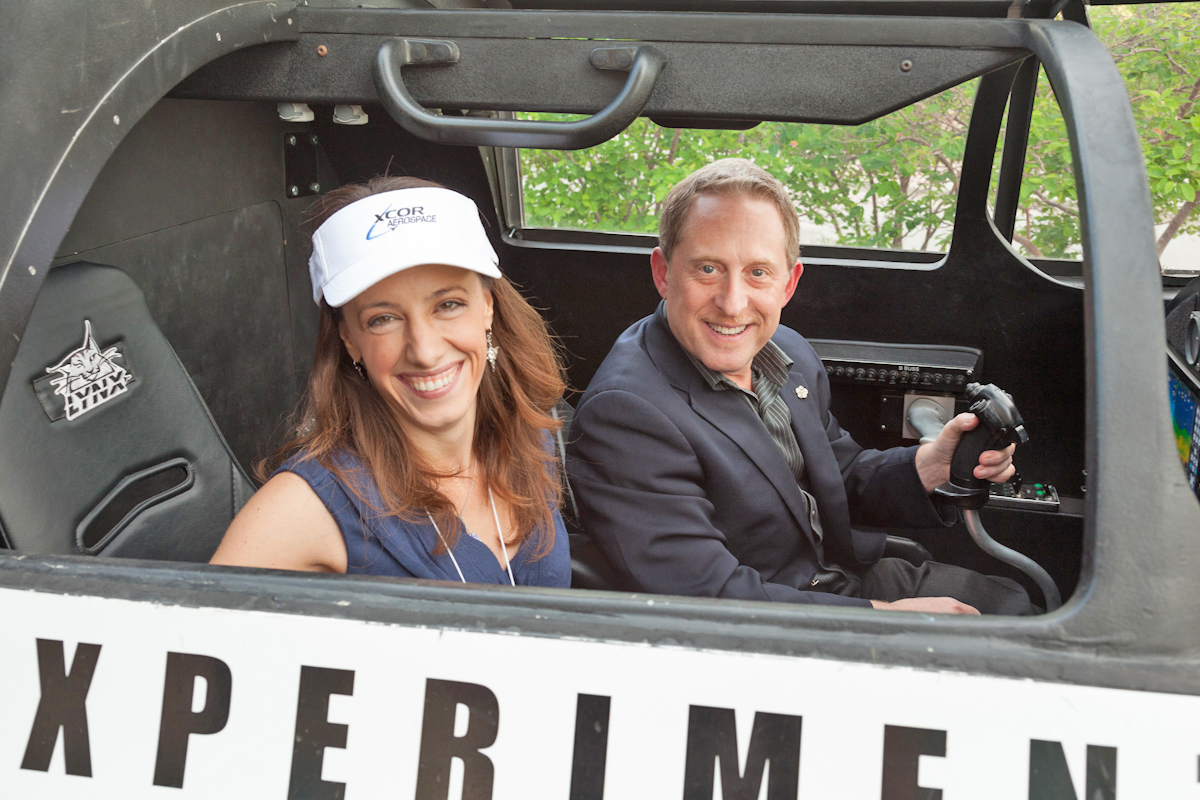
NSRC 2013 was back in Colorado, this time Broomfield just outside of Boulder. One of the first things I did upon arriving was climb into a lifesize model of the XCOR Lynx and pretend to fly. I had just started my new job at the Center for the Advancement of Science in Space three months prior and I gave my first public CASIS talk at the conference. Speakers not previously mentioned included Charlie Walker, Mike Lopez-Alegria, Scott Parazynski, Stu Witt, Wayne Hale, Mike Suffredini, Mark Sirangelo, and Jane Poynter.

Flying the XCOR Lynx - NSRC 2013
Where will Alan Stern fly us to in this Lynx ride among the stars? - NSRC 2013


I raced my friend Ryan Kobrick in assembling Lego Lynx models (he won, just barely). I sang Queen's Bohemian Rhapsody with a table full of inebriated professionals. I stayed up really, really late chatting about space with other like-minded dreamers. I wrote, “I really can't believe that all of this is happening to me. NSRC is the best conference ever.”

Legos! - NSRC 2013

And now, NSRC is back after a 3 year hiatus! Originally planned to be an every-18-months conference from 2012 onward, the fifth NSRC was delayed until enough progress in the industry justified the meeting. I'm looking forward to hearing from researchers, flight providers, and everyone else involved! Speakers not previously mentioned include Alan Eustace, Steve Jurczyk, David Miller, John Olson, Jason Reimuller, and Steve Collicott. I'm looking forward to seeing old colleagues and meeting news ones!

And what's sure to convince everyone that I'm crazy, I'll be attending with a baby. This will be a challenge, for sure, but I'm up for it!


For more information, visit http://nsrc.swri.org